

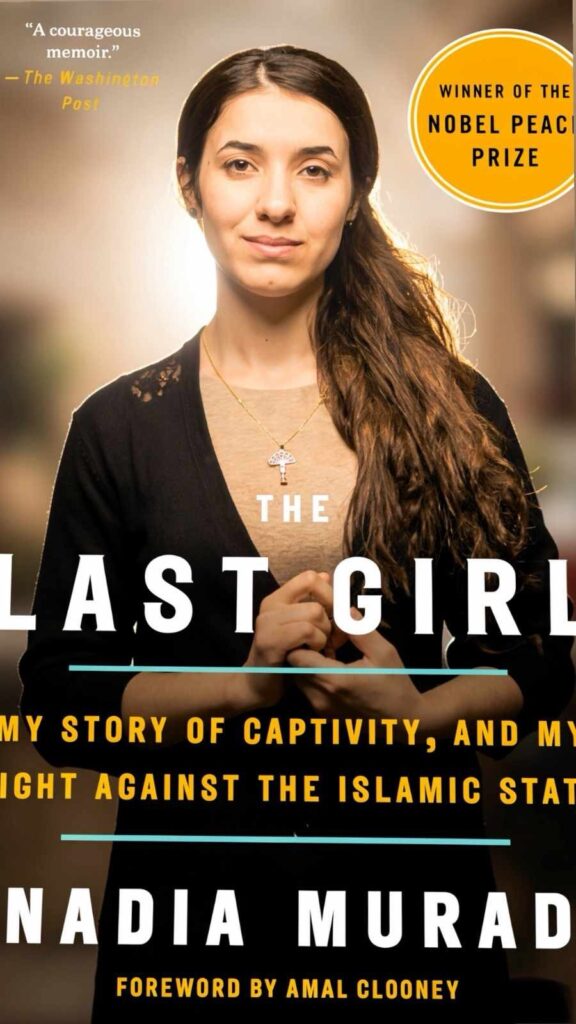
Published in 2017, The Last Girl is Nadia Murad’s memoir of her childhood in Kocho, her abduction and enslavement by ISIS, and her escape from captivity. Written with Jenna Krajeski, the book is both a personal testimony and an account of the genocide committed against Ezidis.
When Nadia Murad opens The Last Girl by saying, “This book is written for every Ezidi,” she makes it clear that this is more than her personal story. It is the story of an entire people. Yet I believe this book is not only for every Ezidi; it is a book the entire world must read.
I have owned The Last Girl since the day it was published, but I was never emotionally ready to open it. When I finally found the strength to begin, August was approaching—a month that forever reminds us of the genocide against the Ezidis and of Kocho, where one of the most horrific massacres took place.
Before ISIS enters her story, Nadia introduces us to her life in Kocho. Through her words, you feel the warmth of her family, the simplicity of village life, the traditions, the laughter and the deep sense of belonging that defined her childhood. At the same time, you begin to sense the hatred that had long surrounded the Ezidis—a hatred that many had carried for years, waiting for the moment when they could finally act on it.
As the siege of Kocho unfolds, every page becomes heavier. You are pulled into the fear, the uncertainty and the unbearable reality of not knowing whether you will still be alive in an hour, tomorrow or ten days from now. Nadia’s writing places you beside the people of Kocho. You do not simply read their story; you feel it.
Then comes the unimaginable.
Nadia recounts the systematic brutality she endured with remarkable honesty. She writes about being torn from her family, sold into sexual slavery, raped, beaten and forced to renounce her faith. What makes her testimony even more devastating is the quiet humanity behind it. After every assault, she prayed for God’s forgiveness, believing that she had somehow failed, even though every crime committed against her was forced upon her. When she was coerced into converting to another religion, she prayed again, knowing that her faith remained untouched in her heart. No amount of violence could take away her identity. No amount of cruelty could erase the fact that she would always remain Ezidi.
When Nadia finally decides to escape, she steps into the darkness with no certainty that she will survive. She does not know where she is going or whom she can trust. She simply chooses freedom over fear. Against all odds, she reaches a Muslim family who risk everything to protect her. Their courage reminds us that, even in humanity’s darkest moments, there are still people who choose compassion over hatred.
What Nadia did after her escape is just as extraordinary as surviving captivity. Instead of allowing her suffering to remain hidden, she transformed it into a voice for thousands who could no longer speak. She stood before the world and forced it to confront the truth. She became the first Ezidi woman to receive the Nobel Peace Prize, not because she sought recognition, but because she refused to let genocide be ignored or forgotten.
The Last Girl is not simply a memoir. It is testimony. It is evidence. It is history written by someone who survived what no human being should ever endure. Through one woman’s story, we witness the suffering of an entire people, especially the women and girls whose lives were shattered by genocide. Yet Nadia’s story is only one among thousands. Countless voices remain unheard. Countless stories remain untold.
This book breaks your heart, yet you cannot stop turning the pages. Every chapter compels you to continue, not out of curiosity, but out of a responsibility to know the truth.
Everyone should read The Last Girl. Not because it is an easy book, but because it is a necessary one. We cannot claim to value human rights while remaining ignorant of one of the most horrific genocides of our time. We cannot say “never again” if we are unwilling to listen to those who survived.
Read this book. Read it to understand. Read it to remember. Read it because truth deserves witnesses, because silence protects perpetrators and because the stories of the Ezidi people must never be forgotten.