
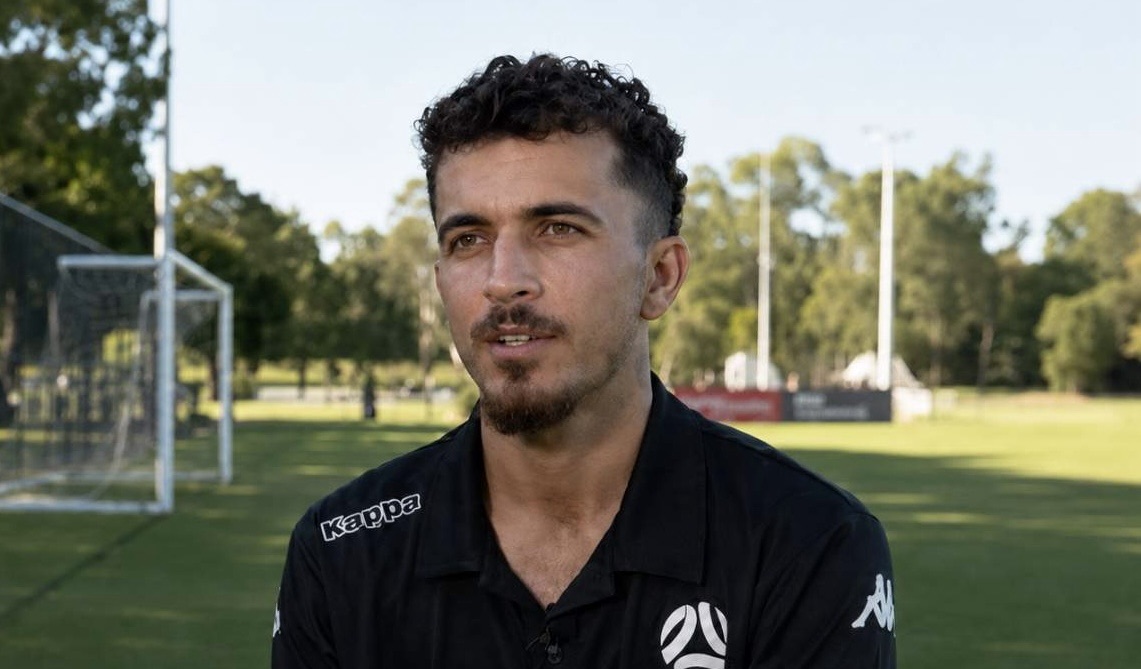
A young Ezidi refugee who survived two years in ISIS captivity as a child has spoken about rebuilding his life in Australia, where he now teaches English and works as a qualified football referee.
Sulaiman Z., 23, was recently featured by ABC News as part of ABC Your Say, a national project inviting people across Australia to speak about the issues affecting their lives. While the wider report examined growing dissatisfaction with housing costs, financial pressure and politics, Sulaiman expressed deep gratitude for the security, freedom and opportunities he has found since arriving in the country as a refugee.
His positive outlook is shaped by an experience very different from that of most Australians. Before settling in Queensland, Sulaiman endured captivity, displacement and several years without a permanent home.
From ISIS captivity to Australia
Sulaiman was twelve years old when ISIS captured him and members of his family during the genocide against the Ezidi people in 2014.
The family remained in captivity for approximately two years before escaping in 2016. They then spent another two years in a refugee camp before being resettled in Australia.
Sulaiman arrived at the age of fifteen without speaking English and settled in Toowoomba, a regional city in Queensland about 150 kilometres west of Brisbane. He enrolled at Harristown State High School, where he began learning English and adjusting to a new education system after years of captivity and displacement.
His transition required more than learning a language. He had to adapt to a different society, rebuild a sense of stability and continue his education after losing several formative years to violence and forced displacement.
Returning to the school where he learned English
Sulaiman has since returned to Harristown State High School as an English teacher.
The school serves students from more than forty countries, including many who are learning English as an additional language or dialect. Sulaiman’s own experience of arriving in Australia without English gives him a direct understanding of the uncertainty and difficulty faced by newly arrived students.
He is now able to support young people confronting some of the same linguistic, educational and social challenges he once experienced himself. The school where he began rebuilding his own future has become the place where he helps other students establish theirs.
His work also demonstrates how refugee resettlement can extend beyond immediate safety. Access to education, stability and long-term support allowed Sulaiman not only to continue his own studies, but eventually to contribute to the institution that helped him after his arrival.
Building a life through football
Football has also remained an important part of Sulaiman’s life.
He is now a qualified referee and officiates matches in Queensland’s men’s National Premier League. The role requires confidence, discipline, communication and the ability to make decisions under pressure.
His work at the school and on the football field has strengthened his connection to Toowoomba, the city where his family began rebuilding their lives. He has spoken with particular appreciation for the people, institutions and legal protections that supported him after his arrival.
Sulaiman’s perspective stood in contrast to the wider dissatisfaction examined in the ABC report. Research cited by the publication found that many Australians were experiencing declining life satisfaction amid housing shortages, financial insecurity and concern about the country’s direction.
Migrants born in non-English-speaking countries, however, were found to express more positive attitudes towards Australia despite often facing greater economic vulnerability.
For Sulaiman, freedom, security and the opportunity to study and work carry particular meaning after captivity, forced displacement and years spent in a refugee camp. His message centres on patience, kindness, personal responsibility and continuing to work towards one’s goals despite hardship.
The importance of accurate Ezidi representation
The ABC report identifies Sulaiman as Ezidi and explains that his family was captured by ISIS during the 2014 genocide. However, it also describes Kurmanji as the “traditional Ezidi dialect.”
That description is inaccurate and politically loaded.
A language spoken by many Ezidis does not determine or replace the ethnicity of the Ezidi people. Ezidis are a distinct ethnic and religious people, and linguistic terminology should not be used to absorb their identity into another national framework.
The language associated with Ezidis should be described accurately and without implying that the Ezidi people are merely a religious subgroup of another ethnicity. Sulaiman’s identity and experience must be presented within the history of the Ezidi people and the genocide committed against them.
A life rebuilt beyond survival
Sulaiman’s story is not limited to what he endured under ISIS. It is also about education, work, responsibility and participation in the society that received him.
He arrived in Australia as a teenager without English after spending years in captivity and displacement. Today, he teaches students at the school where he once learned the language, officiates football matches and speaks openly about the opportunities he has found in Australia.
His life reflects what can become possible when survivors are given safety, education and the opportunity to rebuild with dignity. It also demonstrates that the genocide, although permanently part of an individual’s history, does not have to define the limits of an Ezidi survivor’s future.