
This overview of Çarşema Sare Nîsanê (Ezidi New Year according to Sharfadin), also known as Aida Sarsale. Deeply connected to renewal, fertility, remembrance, and the blessing of the earth, the feast reflects both spiritual devotion and the close bond between nature, seasonal life, and sacred custom among Ezidis.
The original material is from “Yezidi Sarhad,” based in Tbilisi, Georgia.
The Ezidi festival of Çarşema Sare Nîsanê, also known as Aida Sarsale, corresponds more closely to the Babylonian New Year, and many elements of the celebration of both festivals overlap. In general, it should be said that all of these holidays are connected with spring, sowing, life, and the cult of fertility.
According to Ezidi sacred texts, this is the feast of Tawûsî Melek, the Head of the Angels, who, by the will of God, adorns the earth and gives it life.
On the eve of the festival, food is prepared in every household, and on New Year’s night, as the new day begins, the food is blessed.
Ezidis say that the month of Nîsan (April) is the bride of the year (bûka salê), and for this reason weddings are strictly forbidden among Ezidis during this month. According to their belief, by April the land should already have been ploughed by the farmers and prepared for sowing.
At the same time, Ezidis also commemorate their deceased. On the eve of the feast, they bake kulîç cakes and sewke bread, distributing them to those in need or to neighbors, and in the morning they go to the graves of the departed carrying fruit and other foods.
Young people go out into the fields to gather the red flowers of April and, tying them into bundles, hang them above the entrance door as a sign of blessing for the inhabitants of the house; these flowers are considered offerings to Tawûsî Melek. By morning, all the homes are beautifully decorated, and the lady of the house places on the table eggs dyed red, yellow, and green, symbolizing life and the diversity of the world.
On the same day, farmers go out into the fields and scatter multicolored eggshells over the sown الأرض so that the land may yield a rich harvest that year. In addition, shepherds set aside a little mast (yogurt) and preserve it as haven (starter culture) for the whole year.
After this feast, throughout the month, the days of the saints are celebrated daily in Ezidi villages in the form of the so-called tewaf. In every village, general rejoicing begins. Ezidis form great circle dances and dance to the music of the zurna and drum.
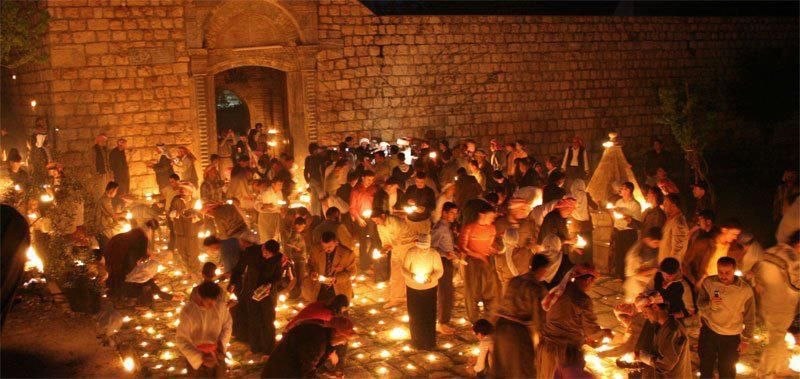
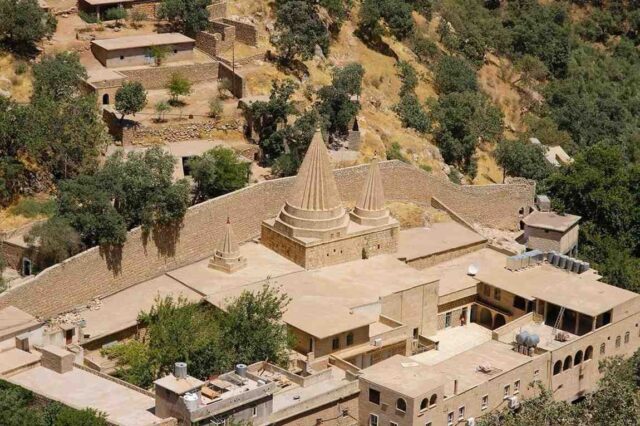
During this festival in Lalish, the clergy recite prayers and sacred hymns, and by evening oil lamps are lit. The Ezidi temple of Lalish lies in a deep and picturesque valley with a single exit. The slopes of the surrounding peaks are covered with the dense greenery of walnut, mulberry, and olive trees. Along both slopes of the four mountains—Mşat, Arafat, Mşrûgia, and Hezret—stretch rows of small buildings in which, on feast days, the people who have come to venerate the sanctuary take up residence.
The water flowing from an underground spring, winding through a network of subterranean caves and emerging beneath each of the towers of the ancient temple, bears the mark of holiness. The portals that once served as entrances to the temple are adorned with deeply carved stone reliefs of various symbols. At the center stands a large vaulted hall, whose seven columns support the dome. Since time immemorial, people have come here from all directions, thirsting for knowledge.
On the walls of Lalish and on the surrounding buildings, wicks burn throughout the valley during this feast night. The valley of Lalish shines with the lights of hundreds of lamps, giving it an astonishingly beautiful appearance.

Well done