
A new academic study finds that many male Ezidi survivors who were abducted as boys and forced into IS captivity have still not received the mental health care they need.
More than a decade after the 2014 Ezidi genocide, a new study has highlighted a painful and often overlooked reality: many male Ezidi survivors who were abducted as children and forced into IS captivity still lack proper mental health support.
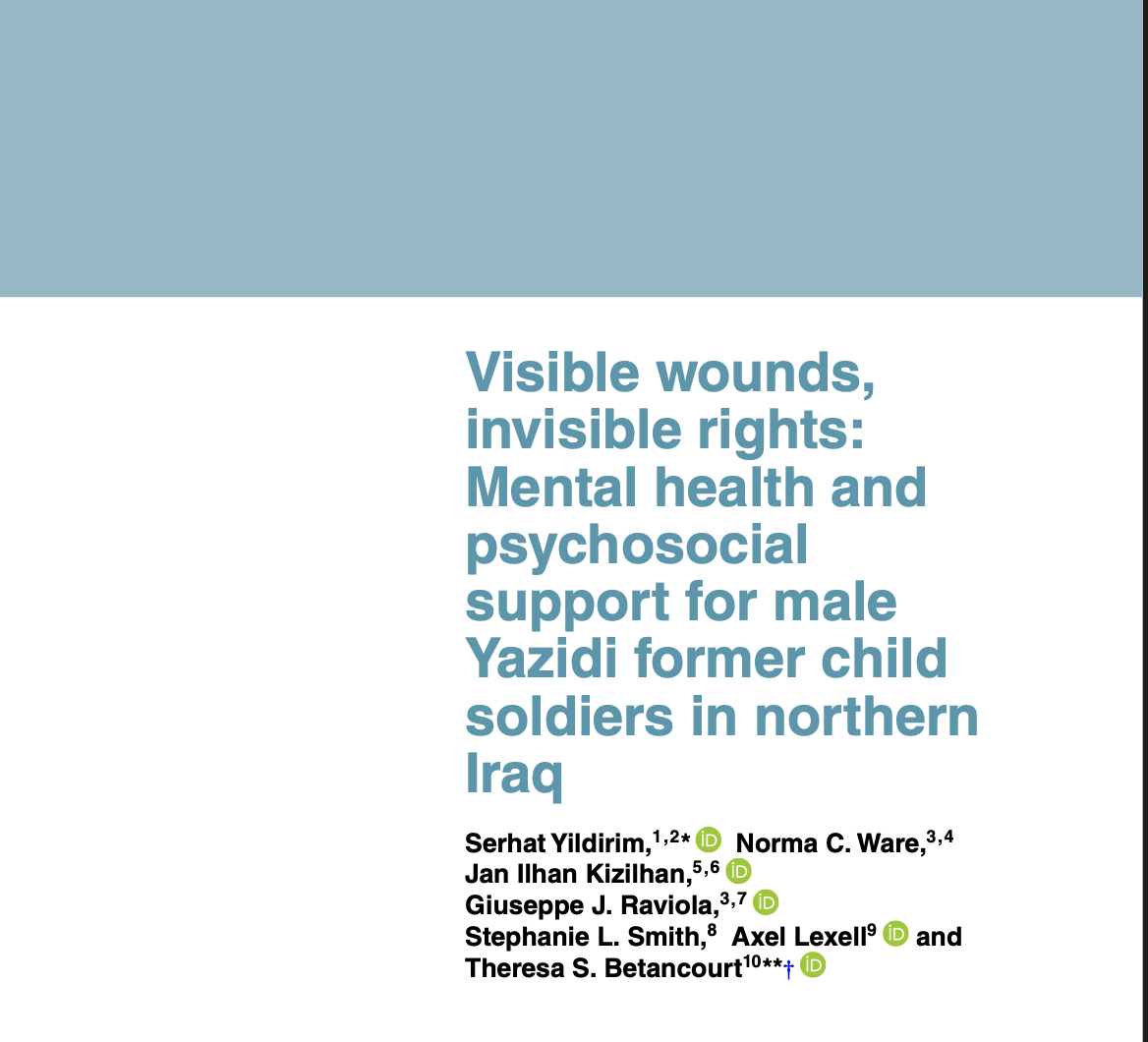
The study1, published in the International Review of the Red Cross, focuses on male Ezidi former child soldiers in northern Iraq. These were boys who were taken by IS during the attack on Sinjar in 2014, separated from their families, exposed to violence, and in many cases forced into military training, ideological control and combat-related roles. The formal term used in international law is “children associated with armed forces or armed groups,” but for the public, the issue is simple: these were children, they were taken by force, and they returned carrying severe trauma.
According to the study, IS abducted Ezidi boys aged between 8 and 14 during the 2014 attack. By 2020, around 300 to 400 male Ezidi former child soldiers had escaped captivity and returned, many of them living in displacement camps or unstable conditions. Many remain difficult to reach because they fear being judged, misunderstood, or even treated as suspects because of what IS forced them to endure.
The study included 30 male Ezidi former child soldiers and 10 mental health providers working with Ezidi survivors. Its findings are clear: the need for care is serious, but the actual support available is limited. Among the 30 survivors in the study, 70% had not received any mental health care since captivity. At the same time, almost all of them — 96.7% — acknowledged that they needed mental health care. Yet only one person was currently seeking it.
This gap is one of the most important findings of the study. It does not simply mean that the survivors do not need help. It means that many were not reached when help was most needed. Some did not know where to go. Some were never approached by mental health providers. Some felt that available programmes were mainly designed for female survivors. Over time, disappointment, stigma and the feeling that it was “too late” made many of them stop seeking support.
This is not a criticism of support for female Ezidi survivors. Female survivors of IS captivity endured horrific crimes and must continue to receive long-term protection, care and justice. The problem is that male Ezidi child survivors also need specific care. Their trauma is different in form, but not less serious. Many were abducted as boys, exposed to violence, forced into IS ideology, separated from their families and returned to society with wounds that are not always visible.
The study also shows that mental health support in northern Iraq depends heavily on NGOs. These organizations have played an important role since 2014, especially because public mental health services remain weak. However, many NGOs were created as short-term emergency responses. More than ten years later, several are facing funding problems, staff shortages, limited medication and logistical barriers. This leaves survivors dependent on services that may disappear or become harder to access.
Location is another major problem. Some services exist in the Duhok governorate, especially around displacement camps, but access is weaker in Sinjar. Survivors may face long distances, transport problems, insecurity, and a lack of qualified specialists. For a person already dealing with trauma, unemployment, displacement and social stigma, these barriers can be enough to stop them from seeking help entirely.
The study also raises an important legal issue. Under international child protection standards, children who are forcibly recruited or used by armed groups should be treated as victims. They are entitled to recovery, reintegration and protection. They should not be treated as criminals for acts or associations forced upon them as children. The study argues that male Ezidi former child soldiers must be recognised as survivors who need support, not suspicion.
This distinction matters deeply. Many Ezidi boys taken by IS were children at the time of their captivity. They did not choose their abduction. They did not choose the ideology forced upon them. They did not choose to be separated from their families, faith, Sharfadin, identity and people. Their return should have been met with structured care, family support, education, reintegration programmes and long-term psychological treatment.
Instead, many have returned to a life marked by unemployment, interrupted education and untreated trauma. In the study, all 30 participants were unemployed, and most had not returned to school after captivity. This shows that mental health cannot be separated from daily life. Survivors need therapy, but they also need education, work opportunities, social acceptance and a safe future.
The main message of the study is straightforward: male Ezidi former child soldiers have been overlooked for too long. Their suffering may be less visible than physical injury, but it is real. Their rights exist on paper, but those rights must be translated into actual care, accessible services and long-term support.
For Ezidi society, this issue is not only medical. It is about justice, dignity and survival after genocide. Every Ezidi child taken by IS was targeted as part of an attempt to destroy the Ezidi people. Supporting these survivors is therefore part of repairing what IS tried to break.
The study calls for tailored, trauma-informed mental health services for male Ezidi former child soldiers. It also calls for better coordination between governments, NGOs and international organisations, as well as a clearer referral system so survivors know where to go when they need help.
More than ten years after the genocide, the world cannot claim that the suffering of Ezidi survivors is unknown. The evidence is there. The need is there. What remains missing is a serious, long-term system that treats male Ezidi former child soldiers as what they are: survivors of genocide, children who were harmed by IS, and human beings entitled to care, dignity and a future.
1. Yildirim, Serhat, Norma C. Ware, Jan Ilhan Kizilhan, Giuseppe J. Raviola, Stephanie L. Smith, Axel Lexell, and Theresa S. Betancourt. “Visible Wounds, Invisible Rights: Mental Health and Psychosocial Support for Male Yazidi Former Child Soldiers in Northern Iraq.” International Review of the Red Cross, 2026, 1–39.