In a recent opinion article, Joseph Sliwa, President of the Beth Nahrain Patriotic Union, asks why the KDP persistently draws Christian clergy into political affairs while disregarding the political organisations that actually represent the Chaldean–Syriac–Assyrian people.
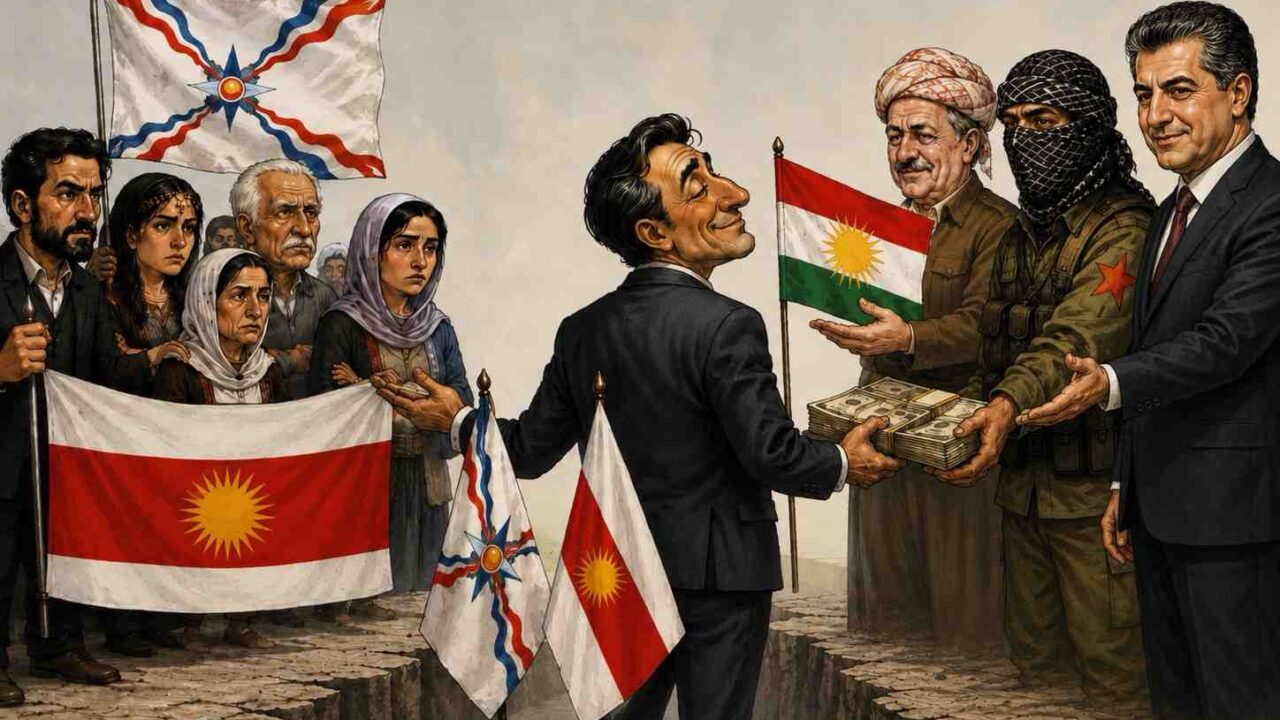
He explain that teligious figures are easier to approach, flatter and influence because politics is not their primary field. By treating clergy as political representatives, the party can bypass independent Assyrian voices, enter Assyrian society through religious institutions and then present its own objectives as though they carried the approval of the people.
Dear Assyrian friends: Ezidis recognise this method immediately.
This political strategy is used against us too. With Assyrians, the party approaches priests, bishops and other members of the clergy. With Ezidis, it is the Hazim Tashin Beg figure. They take him to official meetings and presents him internationally as the “prince of Ezidis” and representative of the entire Ezidi people.
A “prince” without a democratic mandate
Let us begin with the obvious: Hazim Tahsin Beg is not an elected president of the Ezidi people. Ezidis across Iraq, Germany, Armenia, Georgia, Russia, Syria and the wider diaspora did not vote for him. He has never received a democratic mandate authorising him to determine our ethnic identity, political future or collective rights.
The word Mir is frequently translated into English as “prince.” But international institutions then treat that translation as though it gives one hereditary household political sovereignty over every Ezidi in the world.
It does not.
No family owns the Ezidi people. No inherited title gives one man the right to redefine our ethnicity, speak in our name on every political matter or surrender our identity to another nationalist project. Especially when this same Hazim Tashin Beg has fluctuated in his position several times; at one point he claimed that Ezidis are Arabs, then he claimed Ezidis to be “kurd-Ezidis”, then later proceeded to claim that there is no Ezidi ethnicity and that Ezidi is just a “kurdish religion”. You get the picture.
Although, some claim that he may have folded and bent his ways to protect and ensure the survival among both Arabs and Kurds; the fact remains; he has done nothing other than damage the development, social inclusion and protection of Ezidis. If anything, he did not manage to protect Ezidis with his traitorous actions; these two decades we were subjected to genocide in 2007 and 2014.
Even his selection was not universally accepted. Reporting from Iraq and independent analysis have documented opposition to his appointment, while some Ezidis in Sinjar have continued to reject his authority. His accession did not produce the universal Ezidi consent that governments and political organisations now pretend exists.
Yet foreign officials, political leaders and regional institutions repeatedly receive him as the “prince” or “spiritual leader” of all Ezidis. A British parliamentary answer confirms that a UK minister and special envoy met him in that capacity, while regional authorities routinely present him as the person authorised to discuss Ezidi affairs.
Who gave him that universal mandate?
Certainly not the Ezidi people.
The party relationship is not a secret
The political connection is not an invention by his critics. An official parliamentary archive lists Hazim Tahsin Beg’s political affiliation as the KDP. He previously served as a parliamentarian affiliated with the party.
A former party politician is now presented as a supposedly neutral hereditary representative of an entire people. He meets the same political leadership, appears at its institutions and is then introduced to governments abroad as though he were an independent voice carrying the uncontested will of all Ezidis.
That is not neutral representation. It is political representation hidden beneath a traditional title.
The party does not need to defeat independent Ezidi voices in an open argument when it can simply place a familiar, party-aligned figure in front of international officials and call him “the Ezidi prince.”
The method is efficient:
First, bypass independent Ezidi intellectuals, organisations, researchers, survivors and political representatives.
Then elevate one prominent figure.
Give him access, ceremonies, official photographs and diplomatic meetings.
Present him as the voice of all Ezidis.
Finally, treat whatever he says as evidence that the Ezidi people have consented.
We have not consented. If anything, Hazim Tashin Beg has only been harassed when visiting Ezidis. That should at this point be enough to show that Ezidis say NO to Hazim Tashin Beg.
When one man is allowed to redefine an entire people
The danger is not theoretical. Shortly after assuming the position in 2019, Hazim Tahsin Beg stated in an interview that Ezidis were religiously distinct but Kurdish “by nationality.”
The man presented internationally as the representative of all Ezidis openly placed our ethnic identity beneath another national identity.
He did not say that this was his private political opinion. He spoke while carrying a title that governments interpret as giving him authority over the entire Ezidi people.
That is precisely why this system is so corrupt and nothing but dirty Kurdish politics. The worst of its kind.
When he enters a ministry, parliament, embassy or international conference, officials may assume that he speaks for us. When he reduces Ezidis to a religious “community”, that formulation can be repeated in government papers, institutional reports, academic programmes and diplomatic discussions.
Such representation can weaken recognition of Ezidis as a distinct ethnic and religious people. It can affect our claims to independent political representation, cultural protection, language rights, historical recognition and meaningful genocide-prevention measures.
One man does not have the right to cause that damage. No inherited title authorises him to dissolve the identity of millions of Ezidis into another political project.
What has this representation delivered?
Ezidis also have the right to ask what concrete achievements this supposedly universal representation has produced.
How many missing Ezidi women and children were recovered because of these ceremonial meetings?
How many displaced families were able to return safely to Sinjar?
How many mass graves were excavated?
How many perpetrators were prosecuted?
How many Ezidi lands were restored?
How many international institutions formally recognised Ezidis as a distinct ethnic and religious people because of his intervention?
How many times has he confronted the political forces that attempt to assimilate Ezidis rather than standing beside them?
Meetings, photographs, receptions and speeches are not achievements by themselves. Access to powerful people means nothing when that access does not produce measurable protection for the people supposedly being represented.
When the most visible result is that another political movement gains a convenient Ezidi face through which to promote its own identity narrative, Ezidis are entitled to ask a blunt question:
Whom does this office actually serve?
Different people, the same machinery
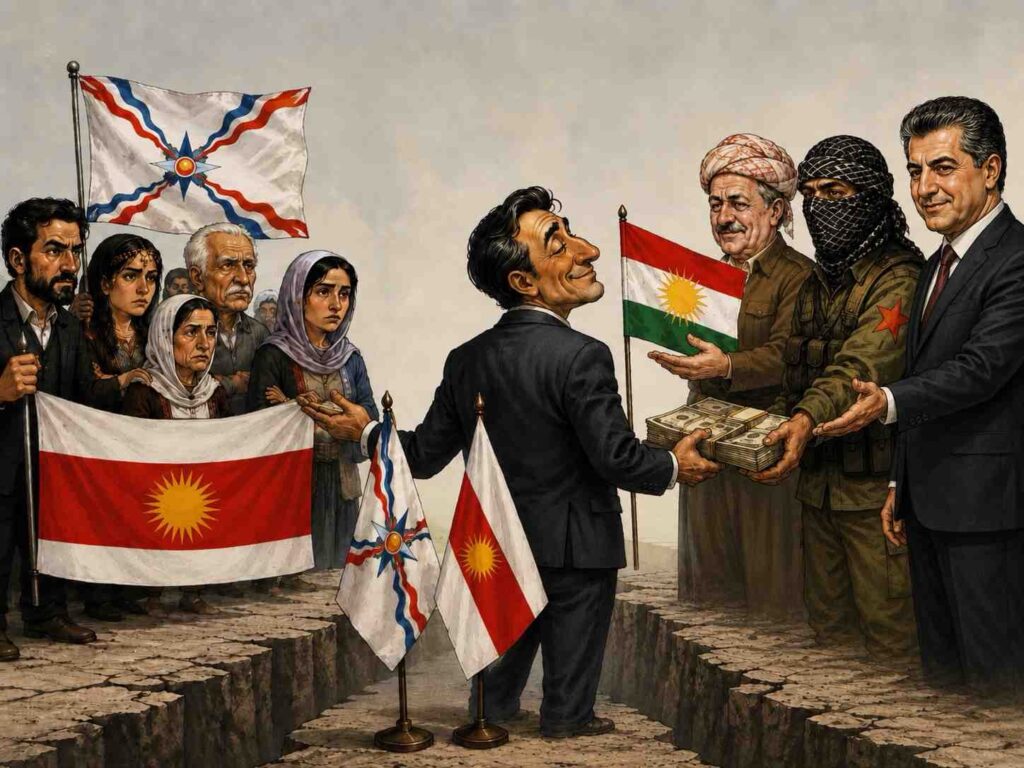
Joseph Sliwa argues that Christian clergy are being used to bypass genuine Assyrian political representation. Ezidis see the same machinery operating through the Mir institution.
The details differ, but the structure is recognisable: Dirty Kurdish Politics
Dear Assyrian friends, you are not alone. We recognise the pattern because it has been used against us for years.
Although, unfortunately, we have some corrupt and disloyal members who are for sale – our identities are not for sale. That is why we should never accept them and resist these cheap and dirty kurdo-philes.