
A critical Ezidi response to Sheikh Zeido Baadri’s article and the attempt to frame Lalish, Sharfadin, and Ezidi identity through Kurdish nationalist language.
Lalish Is Not “a Spring” for Kurdish Nationalist Appropriation!
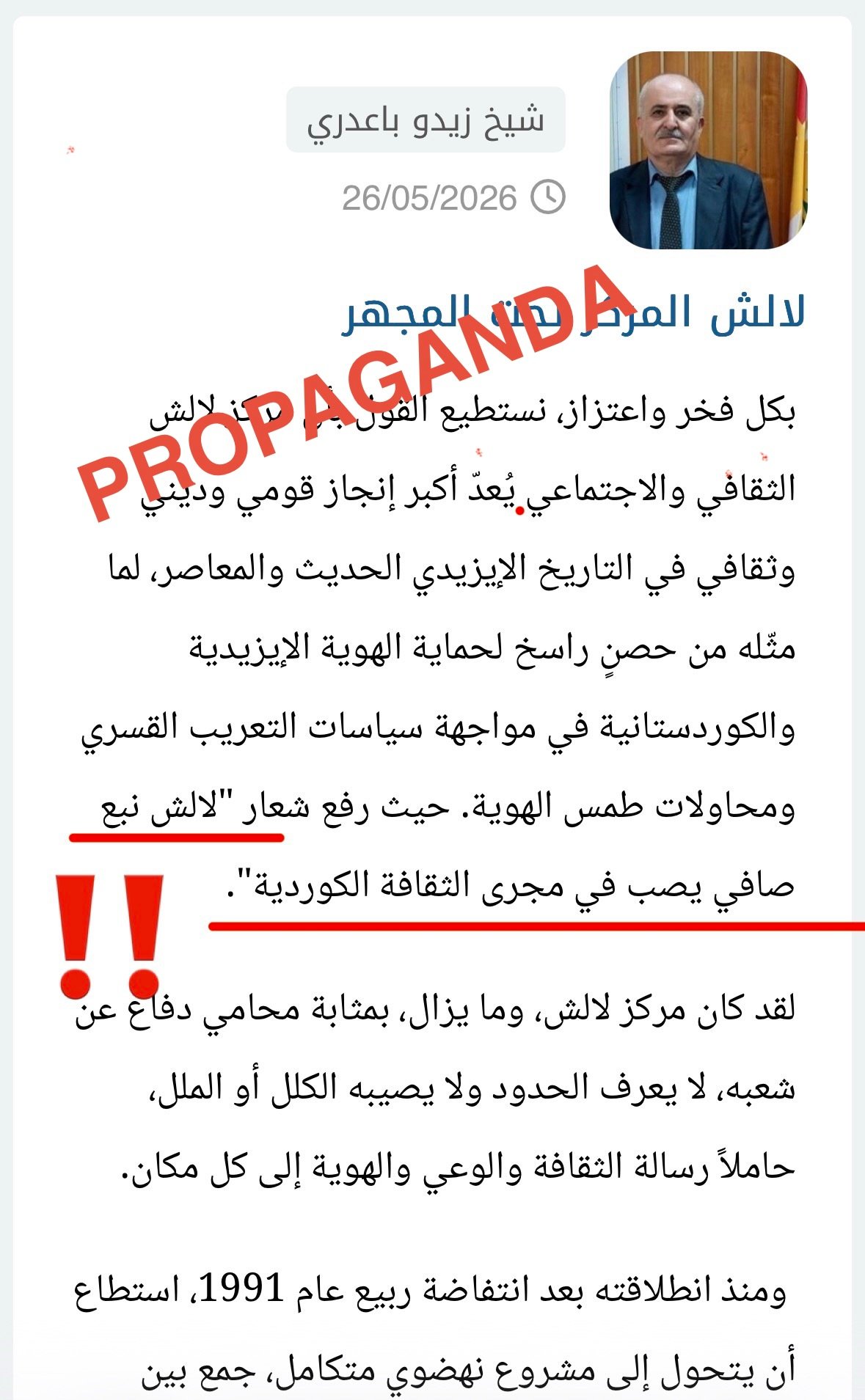
On 26 May 2026, Sheikh Zeido Baadri wrote an article in Arabicabout the Lalish Cultural and Social Center, praising it as one of the greatest national, religious, and cultural achievements in modern Ezidi history. At first glance, the article presents itself as a tribute to an institution that has served Ezidis through cultural work, publications, religious support, student assistance, media, and social projects. But beneath that surface, the article reveals a much deeper and far more serious problem: the repeated attempt to place Ezidi identity, Lalish, and Sharfadin inside a Kurdish nationalist framework. This is not a harmless wording issue. It is not a matter of poetic expression. It is a political and ideological pattern that Ezidis must confront directly.
The most disturbing sentence in the article is the slogan attributed to the Center: “Lalish is a pure spring that flows into the stream of Kurdish culture.”
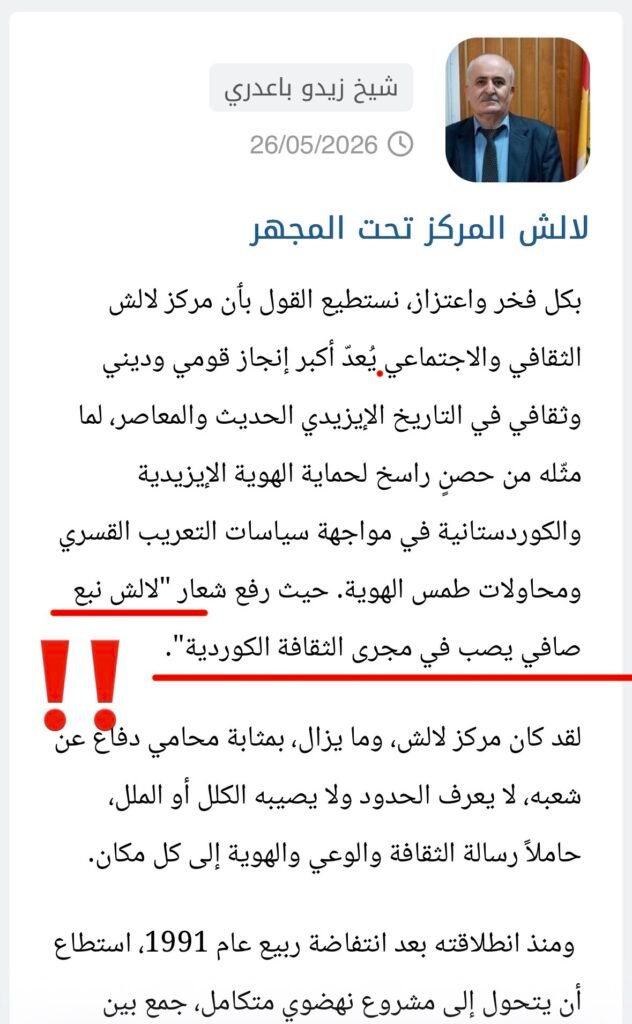
This sentence should alarm every Ezidi who understands what Lalish is. Lalish does not flow into Kurdish culture. Lalish is not a source for Kurdish culture. Lalish is not a cultural accessory, a symbolic decoration, or a spiritual tool to be used for strengthening Kurdish nationalism. Lalish is the holiest temple of the Ezidi people and the spiritual heart of Sharfadin. To describe Lalish as something that flows into Kurdish culture is not respect. It is appropriation, and it must be rejected clearly.
The article claims that the Lalish Center protected Ezidi identity from forced Arabization and attempts to erase identity..
But the irony is obvious. Instead of Arabization, they are doing Kurdification. For Ezidis, Kurdification is equally as bad as Arabization, if not worse, because it often comes disguised as friendship, protection, support, and brotherhood.
Arabization was an external pressure that Ezidis could recognise as a threat. Kurdification is more dangerous when it enters through institutions, speeches, slogans, funding, political visits, and cultural language that pretends to defend Ezidis while slowly placing them under another identity. Replacing one form of identity erasure with another is not protection. It is simply a different method of control.
This is the mentality and logic that many Ezidis understand very well. First, Ezidi institutions are praised. Then Ezidi suffering is mentioned. Then Ezidi sacred places are admired. Then the word “Kurdish” is inserted again and again until the Ezidi centre of the story is weakened. This is how political appropriation works. It does not always come with open hostility. Sometimes it comes with warm language, respectful titles, money, conferences, publications, and symbolic visits. But behind the polished words is a clear attempt to make Ezidi identity appear dependent on Kurdish nationalism, as if Ezidis cannot stand as an ancient people with their own religion, their own history, their own sacred geography, and their own identity.
If the Lalish Cultural and Social Center has served Ezidis, then it must be discussed as an Ezidi institution first, last, and always. Its work should be measured by what it has done for Ezidi students, Ezidi women, Ezidi survivors, Ezidi religious figures, Ezidi publications, Ezidi memory, and Sharfadin. It should not be celebrated as a channel through which Lalish is made to “flow” into Kurdish culture. That framing is an insult to Lalish and to the Ezidi people. No political leader, no institution, no party, no funding structure, and no carefully written article has the right to take the holiest place of the Ezidis and use it to give legitimacy to another nationalist narrative.
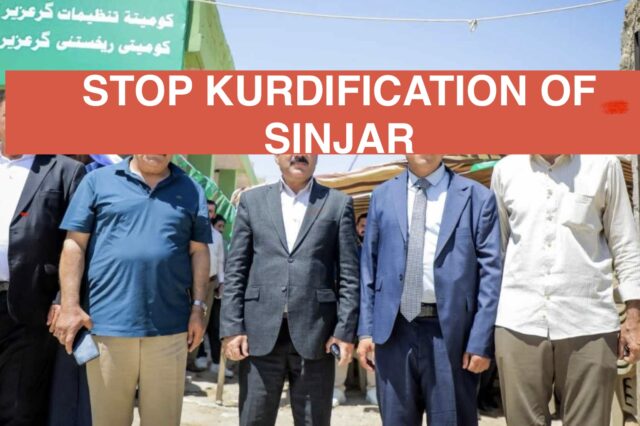
The repeated praise of Kurdish political figures in the article also raises serious questions. When an article about an Ezidi religious and cultural institution becomes filled with Kurdish political framing, the real purpose of the language must be examined. Ezidis do not reject genuine support, but support does not give anyone ownership over Ezidi identity. Assistance does not buy the right to rename us. Political visits do not give anyone the right to absorb Lalish into Kurdish culture. Financial support does not turn Sharfadin into a branch of someone else’s national project. A true supporter of the Ezidi people would say clearly: Lalish is Ezidi, Sharfadin is the Ezidi religion, and Ezidis are an ancient people with their own identity.
The deeper issue is that Kurdish nationalist narratives have repeatedly tried to build legitimacy by absorbing the history, religious heritage, clothing, songs, villages, suffering, and sacred places of surrounding ancient peoples. Ezidis know this pattern because they have lived under it. Our symbols are taken, our pain is used, our religious sites are politicised, and our identity is softened or redirected when it becomes inconvenient. This is why the sentence about Lalish flowing into Kurdish culture is not just offensive; it is revealing. It shows exactly how Ezidi sacredness is being treated as material for another political identity.
This is why Sheikh Zeido Baadri’s article must be criticised firmly. It is not enough to list achievements if those achievements are then framed through language that weakens Ezidi independence. It is not enough to praise Lalish while presenting it as a source for Kurdish culture. It is not enough to speak about protecting Ezidis from Arabization while promoting Kurdification through the back door. Both are forms of identity pressure. Both attempt to move Ezidis away from themselves. Both must be rejected.
Ezidi institutions must now ask themselves a serious question: are they protecting Ezidi identity, or are they allowing themselves to become instruments in someone else’s nationalist project? Are they defending Lalish as the sacred heart of Sharfadin, or are they helping others present Lalish as a cultural source for Kurdish nationalism? Are they serving the Ezidi people, or are they allowing political movements to speak through Ezidi symbols?
The answer must be clear. Lalish is not Kurdish. Sharfadin is not Kurdish. Ezidi identity is not Kurdish. Ezidi institutions must never become instruments of Kurdification, just as they must never become instruments of Arabization. The Ezidi people have survived too much, lost too much, and protected too much to allow their holiest place and deepest identity to be handed over through slogans, speeches, and political flattery.
Lalish belongs to the Ezidi people. Sharfadin belongs to the Ezidi people. Ezidi history belongs to Ezidis. Any article, institution, or political movement that cannot say this clearly is not protecting Ezidi identity. It is protecting and advocating Kurdish nationalism and propaganda.