
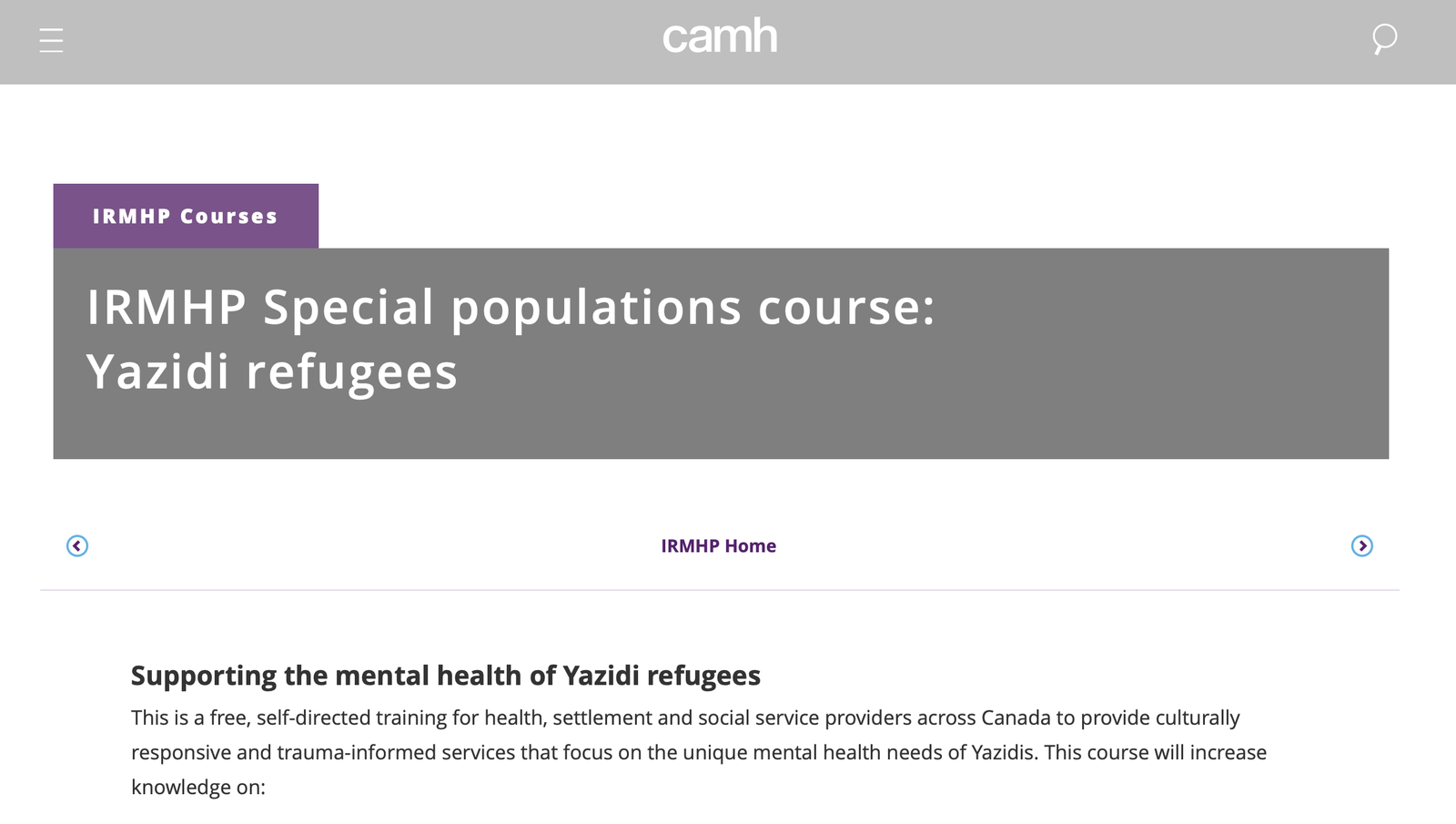
A free online training course in Canada is helping professionals better understand and support the mental health needs of Ezidi refugees.
The course, titled “Supporting the Mental Health of Ezidi Refugees,” is offered by the Centre for Addiction and Mental Health (CAMH). CAMH is Canada’s largest mental health teaching hospital and one of the world’s leading mental health research centres. It is fully affiliated with the University of Toronto and is also a Pan American Health Organization and World Health Organization Collaborating Centre.
The course is self-directed, online and available year-round. It is intended for health, settlement and social service providers across Canada who work with Ezidi refugees. According to CAMH, the training focuses on helping service providers deliver “culturally responsive and trauma-informed services” for Ezidi refugees. The course also addresses gender-sensitive care, the effects of genocide and displacement, and the specific mental health needs of Ezidi women and children.
The training was developed in response to the experiences of Ezidi refugees resettled in Canada after the 2014 genocide committed by the Islamic State against the Ezidi people in Iraq. In 2016, Canada resettled more than 1,000 Ezidi refugees in several Canadian cities, including London, Ontario, as well as Toronto, Winnipeg and Calgary.
Many Ezidi survivors arrived in Canada after experiencing persecution, captivity, family separation, displacement and severe trauma. For service providers, this means that general refugee-support knowledge is not always enough. Supporting Ezidi survivors properly requires knowledge of Ezidi history, culture, family structures, trauma, and the faith of Sharfadin.
The course was also developed after recommendations from the House of Commons Standing Committee on Citizenship and Immigration. In 2018, the committee recommended that Immigration, Refugees and Citizenship Canada strengthen the capacity of service providers to support the mental health needs of Ezidi women and children. CAMH’s course includes five online modules. These cover Ezidi refugees in Canada, the mental health of Ezidi refugees, the needs of Ezidi women and children, promising practices for mental health support, and self-care techniques for professionals working with highly traumatised populations.
This last part is important. Professionals who work with genocide survivors may also be affected by the trauma they hear and witness through their work. The course therefore includes self-care strategies to help service providers remain effective while supporting survivors with care and sensitivity.
For Ezidi refugees, proper mental health support is not only about treatment. It is also about being understood. Survivors who have lived through genocide and displacement may face language barriers, cultural misunderstanding, isolation and difficulty trusting institutions. If service providers do not understand the background of the Ezidi people, support can become distant, incomplete or ineffective.
Training like this can help reduce that gap. It gives professionals a clearer understanding of what Ezidi survivors have endured and what they may need while rebuilding their lives in Canada. The course also shows why culturally informed care matters. Ezidi survivors should not have to explain their entire history, identity and trauma before receiving respectful support. Service providers who work with them should already have the knowledge needed to approach them with dignity, awareness and care.