News reports published in July 2026 used “Yazidi” as hostile descriptions of people and states that have no connection to the Ezidi people. The reports were not discussing Ezidis. They were using language connected to a condemned figure in Islamic history, yet the spelling imposed on our people makes it appear as though our ethnic name is being used as an insult.
This is precisely why Ezidi Times is calling on Ezidis themselves to stop writing “Yazidi” and “Yezidi” These forms do not reflect how we pronounce our name, and their similarity to the name Yazid has created confusion that has followed our people for generations.
[Yezidi/Yazidi] used as a hostile term
The first example appeared on the Russian-language edition of Pars Today on 3 July 2026. The article reported remarks attributed to Iraqi political figure Akram al-Kaabi, who described America and Israel as “the Yazids of our time.”
The context shows that the statement was not about our people. America and Israel were being compared to an enemy figure from Islamic history, while a word identical to the Russian name for Ezidis was used to communicate that comparison.
A second example appeared in an English-language report published by Mehr News Agency on 23 July 2026. Reporting a statement by Iran’s Islamic Revolutionary Guard Corps, the article stated that the United States had revealed its “Yazidi nature.” Once again, nothing in the report concerned the Ezidi people. “Yazidi” was being used as a negative description associated with aggression, betrayal and hostility.
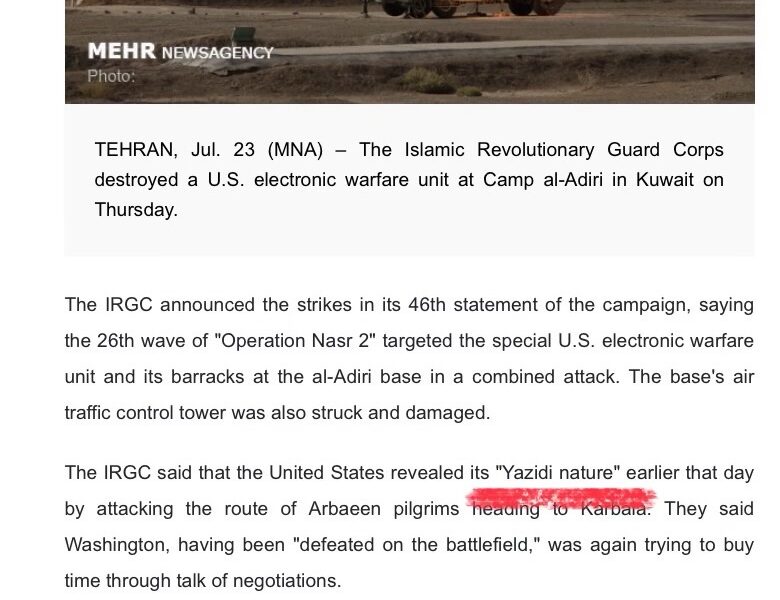
An English-language Mehr News Agency report published on 23 July 2026 states that the United States had revealed its “Yazidi nature,” using a hostile political expression unrelated to the Ezidi people.
The publications were apparently referring to the historical and religious symbolism surrounding Yazid ibn Muawiya, not to Ezidis. Nevertheless, any ordinary reader who sees “Yazidi nature” or “the Ezidis of our time” could reasonably believe that the name of our people is being used as an insult.
A search for “Yazidi” on Mehr News Agency produces two very different types of results. Some articles refer to the Ezidi people, while others use phrases such as “Yazidi nature,” “Yazidi front” and “Yazidi army” as hostile references connected to Yazid ibn Muawiya.
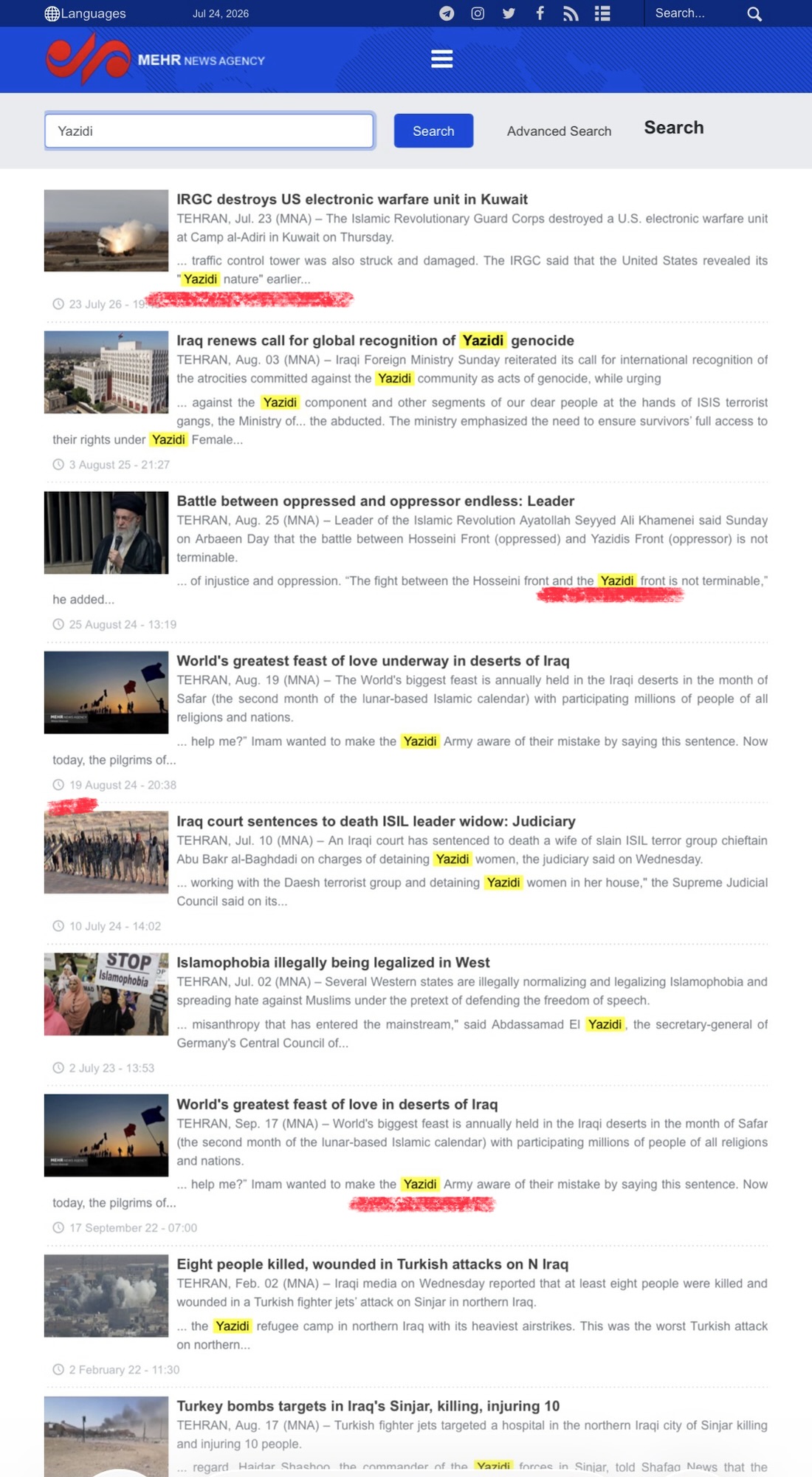
Who was Yazid ibn Muawiya?
Yazid ibn Muawiya, also known as Yazid I, was the second ruler of the Umayyad Caliphate and governed from 680 until 683. During his reign, Husayn ibn Ali, the grandson of the Prophet Muhammad, was killed with members of his family and supporters at the Battle of Karbala in 680. The event became central to Shia religious memory, and Yazid’s name came to represent tyranny, injustice and hostility towards Husayn and his family.
This historical background explains expressions such as “the Yazids of our time.” In this political and religious vocabulary, calling someone a “Yazid” can mean comparing that person to Yazid ibn Muawiya or presenting them as an enemy of justice and religion. The term is therefore deliberately negative, but it has nothing to do with the Ezidi people.
The problem is that outsiders have long written our name as Yazidi, making it look as though it comes from Yazid. This false similarity allows language directed at a seventh-century Muslim ruler to become mixed with the name of an ancient ethnic and religious people who do not identify themselves through him.
The dominance of the Y-based spelling began through Arabic-language religious, administrative and historical writing, where our name was interpreted and recorded according to Arabic pronunciation and connected to Yazid. Foreign researchers, translators and institutions later encountered Ezidis through those sources and repeated the same form, allowing an Arabised version of our name to become internationally established while our own pronunciation, Ezîdi, was pushed aside.
We have never called ourselves “Yazidis”
In our own language, we do not introduce ourselves as “Ya-zidi” or “Ye-zidi.” We say:
Ez Ezdi me.
I am an Ezdi.
When identifying our religion, we say:
Dînê min Şerfedîne.
My religion is Sharfadin.
In Ezdîki, our name is written Ezîdi and is pronounced Ezdi. The form Ezidi, used by Ezidi Times, is a simplified international spelling in which the circumflex is omitted for practical use in English, publishing and digital platforms. It is not a perfect phonetic reproduction, but it preserves the correct initial E and reflects our self-designation far more accurately than “Yazidi” or “Yezidi”.
Our direct self-designation is Ezdi, and Ezidi is the clearest internationally usable spelling because it preserves the sound with which our name begins. Even academic references that use the foreign spelling acknowledge that our people commonly call themselves Ezdi or Ezidi.
The letter Y is therefore not a small or harmless variation. It changes the pronunciation, encourages a false historical connection and places our name inside a linguistic framework created by others. It makes “Ezdi” appear connected to “Yazid” although that is not how we pronounce our own ethnic name or language.
The Y-form was imposed from outside
The spellings “Yazidi” and “Yezidi” became widespread through Arabic usage and were later reproduced in government records, journalism, academic literature and international institutions. Once these foreign forms became dominant in official documents, many Ezidis began using them as well, often because they believed that this was the only spelling recognised by the outside world.
Ezidi Times considers this part of the wider Arabisation of our name. Instead of recording how Ezidis identify themselves, Arabic-speaking authorities and writers adapted the name to a form that resembles Yazid. That version was then repeated through political, religious and administrative systems until it was presented back to Ezidis as the supposedly correct name of our own people.
The consequences are visible in the two reports published in July. Words connected to Yazid ibn Muawiya are used as political insults, yet because our people are internationally called “Yazidis,” the hostile language appears to include us. The confusion was created by an imposed spelling, but Ezidis now have the responsibility to stop reproducing it.
This call is directed at our own people
The purpose of this article is not primarily to condemn Pars Today or Mehr News Agency. Their reports expose the problem, but the people who must act are Ezidis themselves.
Ezidi organisations continue to register themselves under names beginning with Y. Ezidi writers publish articles about “Yazidi culture,” activists speak about “Yazidi rights,” and institutions organise events under the label “Yazidi”.
Every time we repeat that spelling, we strengthen a version of our name that does not reflect our own language and that continues to connect us visually to Yazid ibn Muawiya.
We cannot fully control how every foreign journalist, government or institution identifies us. We can, however, control the language used by our own organisations, publications, researchers and representatives. When Ezidis consistently write Ezidi, outsiders will have less justification for continuing to impose inaccurate alternatives.
This change must begin in our association names, event posters, websites, academic writing, social-media accounts and public statements. Older spellings may remain where an official title or historical quotation must be reproduced exactly, but they should be eliminated from original Ezidi writing.
Ezidi Times calls for one consistent name
Ezidi Times calls on Ezidi organisations, journalists, academics, activists, artists and public representatives to use Ezidi consistently in English. When directly reflecting our pronunciation in our own language, the form is Ezdi, while our religion should be identified by its name, Sharfadin.
This is not merely a debate about spelling. It concerns our right to define ourselves and to prevent our name from being attached to a Muslim ruler, an unrelated historical conflict or a derogatory political expression.
The reports from Pars Today and Mehr News Agency show what happens when our name is written in a form that was never ours. A word intended to invoke Yazid ibn Muawiya becomes indistinguishable from the name of the Ezidi people, leaving our identity vulnerable to misunderstanding and insult.
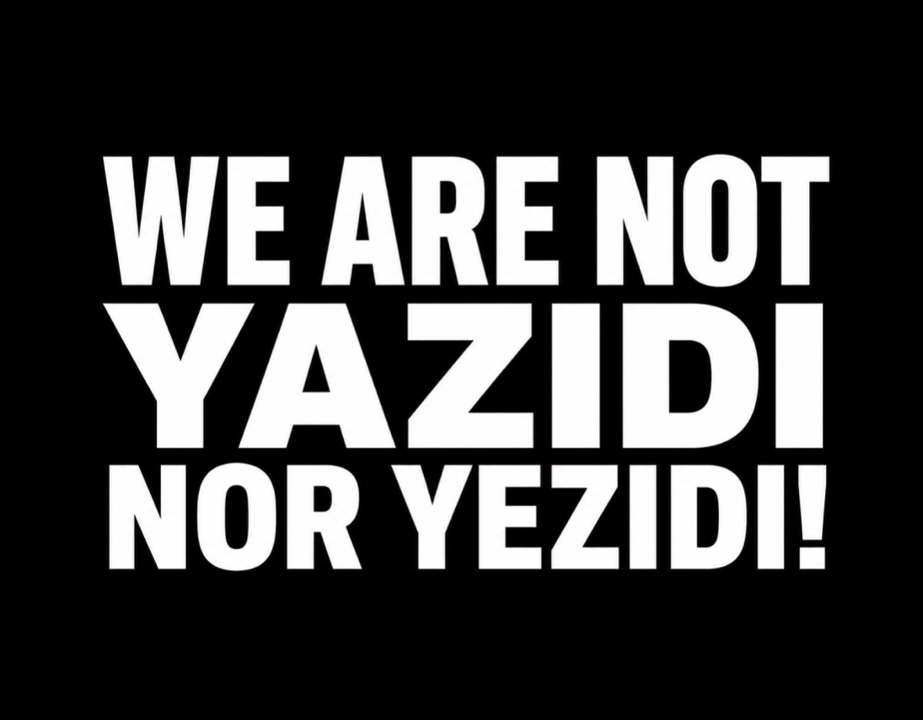
Our people should no longer accept that confusion or participate in maintaining it. We do not call ourselves “Yazidis” or “Yezidis” We say Ez Ezdi me, and the international spelling that best respects that name is Ezîdi (pronounced Ez-di) – nothing else!