
Ezidis returning to Afrin in northern Syria during 2026 have found homes stripped of their contents, cemeteries vandalised and sanctuaries of Şerfedîn damaged or destroyed after eight years of displacement. Field reporting published by New Lines Magazine on 26 August documented how families are resuming ceremonies and caring for sacred sites while facing uncertainty over security, property and whether their return can become permanent.
Among those who returned was Suad Hiso, 52, who reached her village of Qastal Jindo on 10 June in a convoy reportedly carrying approximately 1,700 people. The sanctuary she remembered from before the 2018 Turkish military operation had been reduced to rubble, its old oak tree uprooted and nearby gravestones broken. Her response was not to abandon the site, but to begin practising Şerfedîn there again and to remain committed to restoring the damaged sanctuaries.
Before the Syrian war began in 2011, Afrin was home to the largest concentration of Ezidis in Syria, with New Lines estimating that approximately 60,000 lived in the area. Residents identify 19 sanctuaries of Şerfedîn across Afrin’s mountainous landscape, reflecting the longstanding presence of the Ezidi people in the region.
Turkey and allied Syrian armed groups took control of Afrin in 2018, causing large-scale displacement. Many Ezidis fled eastwards and spent the following eight years separated from their villages, homes, cemeteries and sacred places.
Organised returns began after an agreement reached in January 2026 between Damascus and the administration in northeastern Syria. The agreement created a new route for displaced residents to return to Afrin, although the security, political and property conditions awaiting them remained uncertain.
Returning families have reported finding houses emptied of furniture, household fittings and personal possessions. Some properties were damaged or occupied, while several sanctuaries and cemeteries had been desecrated. New Lines cited research by the Wilson Center indicating that more than half of the Ezidi sanctuaries in Afrin were looted or violated after Turkish-backed armed groups assumed control of the area.
The destruction extends beyond Qastal Jindo. In Basufan, a village with a longstanding Ezidi population, a sanctuary with architectural features resembling those of Lalish was reportedly struck by a bulldozer in 2020. The Ezdina Foundation, which monitors the rights of Ezidis, attributed the destruction to Turkish-backed fighters.
Another sanctuary traditionally visited by women was left inaccessible after a Turkish military position was established on the mountain where it stands. Returning residents have consequently been unable to determine its complete condition or resume ceremonies there.
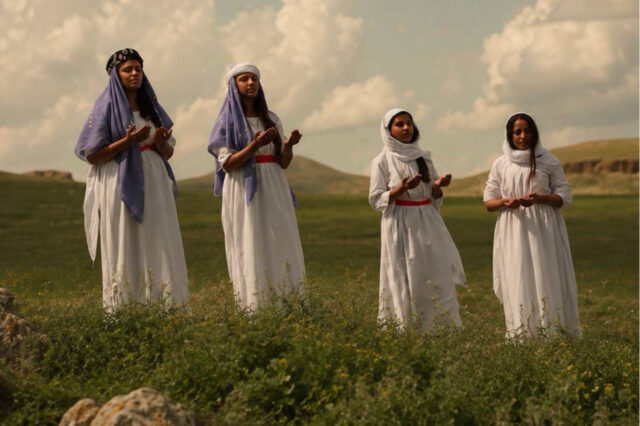
Despite the damage, families have begun restoring the presence of Şerfedîn in their villages. Candles and olive oil have once again been placed at sanctuaries, while sacred objects brought from Lalish have been returned to family homes. Visitors remove their shoes when entering sacred spaces and avoid turning their backs towards them when leaving as a sign of respect.
Hiso also explained the meaning of facing the sun during prayer. Ezidis do not worship the sun; it represents divine light, strength and eternity and provides a sacred direction for prayer. Şerfedîn is centred on belief in one God, with Tawûsî Melek, the Peacock Angel, holding a central place.
The persecution of Ezidis in Afrin did not begin in 2018. Residents interviewed for the report described restrictions under the former Syrian government, including obstacles to celebrating festivals, displaying symbols of Şerfedîn and teaching children about their faith. Ezidi pupils were also required to attend Islamic religious classes in state schools.
After government forces withdrew from Afrin in 2012, the local administration allowed Ezidi schools to operate in the villages and supported the establishment of an Ezidi cultural centre in Afrin city. That centre was later destroyed following the change of control in 2018.
Suleiman Jafar, a member of the Ezidi Union in Syria who returned to find his home stripped of basic fixtures, said the current Syrian authorities had not committed new violations against Ezidis in Afrin at the time of the reporting. He nevertheless remained cautious about the future and said Ezidi organisations were waiting for an appropriate time to seek legal recognition and permission to rebuild their cultural centre.
That uncertainty remains central to the return process. Families may be physically present in their villages again, but lasting return requires protection of property, access to sanctuaries, freedom to practise Şerfedîn, the restoration of cultural institutions and guarantees that armed groups will not subject Ezidis to renewed discrimination or displacement.
For Hiso and other returning Ezidis, rebuilding Afrin is therefore about more than repairing houses. Restoring the sanctuaries, cemeteries and ceremonies of Şerfedîn is essential to preserving Ezidi identity and re-establishing a life that eight years of displacement attempted to interrupt.