
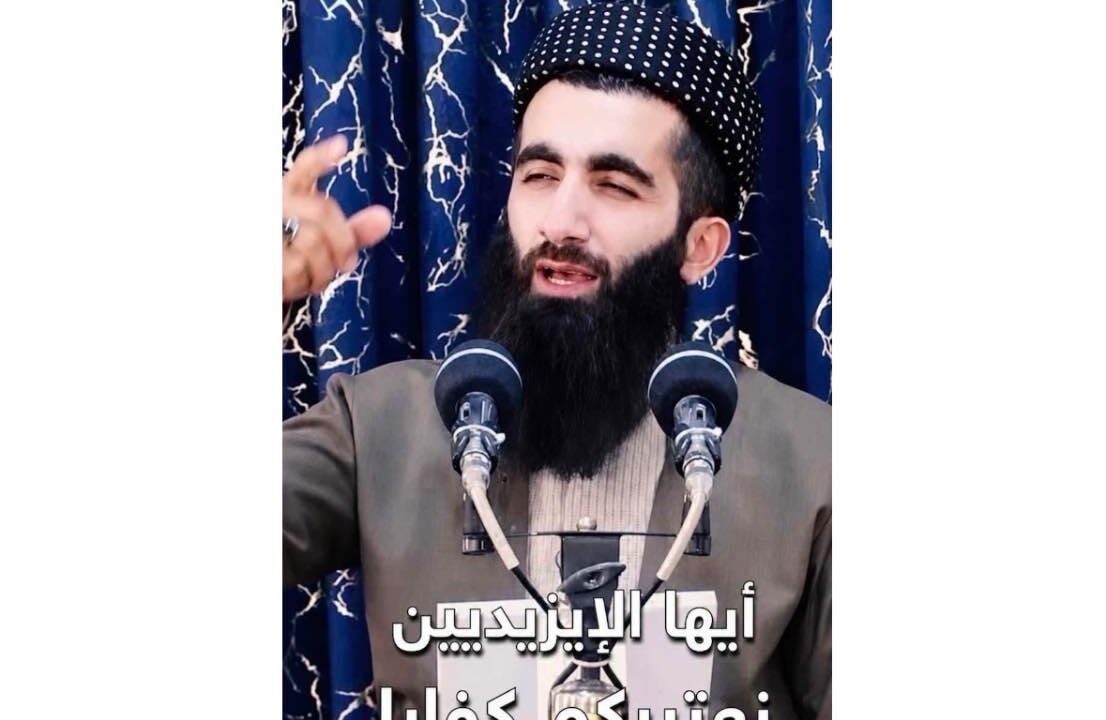
A Kurdish cleric based in Iran has caused serious concern after directing threatening rhetoric towards Ezidis and other minorities in Iraq, including a declaration that they would not be allowed to “live on earth”.
A video of Kurdish cleric Ramin Salehzadeh, which resurfaced in media reports in August 2026, shows him directing hostile religious rhetoric towards Ezidis. Salehzadeh used hostile religious language towards minorities before declaring: “By God, we will not let you live on earth.”
This hate speech comedian only twelve years after ISIS attempted to annihilate the Ezidi people through mass murder, enslavement, forced conversion, abduction and the destruction of their homeland.
They also come during August, the month in which Ezidis commemorate some of the most devastating events of the 2014 genocide.
A threat that carries particular weight for Ezidis
On 3 August 2014, ISIS attacked Sinjar and surrounding Ezidi villages as part of a systematic campaign against Ezidis. Men and elderly people were murdered, women and girls were abducted and subjected to sexual slavery and trafficking, and children were separated from their families, indoctrinated or forced into ISIS structures.
UNITAD, the United Nations investigative team established to investigate ISIS crimes in Iraq, concluded on the basis of clear and convincing evidence that ISIS committed genocide against Ezidis, alongside crimes against humanity and war crimes. (The United Nations in Iraq)
The consequences remain visible twelve years later. According to the United Nations, around 2,600 Ezidis were still missing in 2025 and more than 200,000 remained displaced, while many of those who had returned to Sinjar continued to face inadequate services and difficult living conditions. (United Nations)
Against that history, language telling Ezidis that they will not be allowed to live cannot be separated from the violence that has repeatedly been justified through religious hostility towards them.
The genocide was not created in an ideological vacuum. For generations, Ezidis have been subjected to false accusations about their faith, religious exclusion and campaigns portraying their existence as unacceptable. ISIS took those ideas to their most extreme conclusion.
Statements questioning whether Ezidis should be permitted to exist therefore carry an especially serious meaning.
Hate speech against Ezidis did not end with ISIS
The remarks also emerge against a documented pattern of renewed anti-Ezidi hate speech in Iraq and the surrounding region.
In December 2024, Yazda published a detailed study examining a wave of hate speech directed against Ezidis following the 3 August genocide commemoration that year. Researchers analysed 62 messages taken from 51 screenshots. Of those 62 messages, 25 contained calls for another genocide against Ezidis. (yazda.org)
The campaign created sufficient fear that thousands of displaced Ezidis reportedly left camps and moved towards their areas of origin in Sinjar. Yazda found that hostile rhetoric against Ezidis had increasingly appeared around the annual period in which the genocide is commemorated, raising fears of renewed violence. (yazda.org)
The United Nations has separately acknowledged that the problem persists. During the 2025 commemoration of the genocide, the UN Secretary-General’s Special Representative for Iraq warned that there remain people who promote exclusionary extremist ideas associated with ISIS and spread hate speech. (The United Nations in Iraq)
This makes the reported statement attributed to Salehzadeh particularly concerning. It is not occurring in an environment where anti-Ezidi incitement has disappeared. It is occurring while survivors are still searching for family members, while thousands remain displaced and while openly hostile messages about Ezidis continue to circulate.
Religious rhetoric must not become a licence to threaten a people
Freedom of religious expression does not require societies to accept threats against the existence of another people.
There is a fundamental difference between disagreement over religion and rhetoric declaring that a group should not be allowed to live. When a religious figure directs such language towards a people that has recently survived genocide, authorities, religious institutions and civil society should treat the matter with the seriousness it deserves.
The identity of the speaker also does not lessen the significance of what was said. Salehzadeh’s Kurdish background, if correctly identified, does not make his views representative of Kurds collectively, just as the actions of an individual religious figure cannot be attributed to an entire ethnic or religious population.
Responsibility belongs to the person making the statement and to any institutions or networks that endorse, distribute or encourage such rhetoric.
At the same time, the statement deserves scrutiny precisely because anti-Ezidi persecution has historically been enabled not only by armed organisations but also by ideas spread through religious and social environments in which Ezidis were portrayed as people whose beliefs made them legitimate targets. That history makes it dangerous to dismiss threats as mere words.
Remembrance without prevention is not enough
Every August, governments, international institutions and political leaders repeat the promise that the genocide against Ezidis must never happen again.
But genocide prevention cannot begin only after weapons appear or people are attacked.
It also means recognising the warning signs that precede physical violence: dehumanisation, religious incitement, threats, collective accusations and rhetoric suggesting that an entire people has no legitimate place in society.
The documented hate campaign of 2024 showed how quickly hostile rhetoric can create fear among Ezidis who have already experienced genocide. The continuing displacement of more than 200,000 Ezidis and the unresolved fate of around 2,600 missing people make that vulnerability even more acute. (The United Nations in Iraq)
Twelve years after the genocide, Ezidis should not have to hear public figures threatening whether they will be permitted to continue living.
Authorities and institutions in the countries where such rhetoric originates or circulates should examine threats against Ezidis seriously, identify whether laws against incitement or threats have been breached and make clear that calls for the destruction or removal of a people will not be normalised as religious discourse.
For Ezidis, “never again” cannot be reduced to annual remembrance ceremonies.
It must also mean confronting the ideology and language that can prepare the ground for the next act of violence, before another generation is forced to discover what happens when such warnings are ignored.