

For centuries, the Ezidis, an ancient people of Mesopotamia, have preserved their traditions, beliefs, and identity despite repeated persecution. Within the Ezidi people, women have long played a crucial role in sustaining family life, protecting cultural memory, and supporting the spiritual and social fabric of Ezidi life.
Yet the world’s understanding of Ezidi women changed dramatically after August 3, 2014, when ISIS attacked Sinjar (Shingal), the historic homeland and one of the most important centres of the Ezidi people. The genocide that followed exposed unimaginable violence against the Ezidi people, particularly against women and girls. While the tragedy revealed their suffering, it also revealed something else to the world: the resilience, courage, and leadership of Ezidi women.
Women in Ezidi Life Before 2014
Long before the events of 2014, Ezidi women held important responsibilities among the Ezidi people. They helped support their families, worked in agriculture alongside men, and played a key role in raising generations who preserved Sharfadin (the Ezidi religion). Women were also present within the spiritual life of the Ezidi people, helping maintain sacred spaces such as the holy valley of Lalish and participating in religious traditions that have survived for centuries.
Historical figures such as the respected Mayan Khatun, who led the Ezidi people during a politically sensitive period in the mid-twentieth century, demonstrate that female leadership has deep historical roots among the Ezidi people. However, social restrictions did exist. In many villages, women’s roles were largely confined to the household, and access to education or professional opportunities remained limited.
A 56-year-old Ezidi woman who lived through these decades describes the atmosphere that shaped women’s lives before 2014. She explains that many women were unable to make important decisions about their own futures and often lacked awareness of their rights. Yet she stresses that this was not necessarily because the Ezidi people opposed women’s freedom. Instead, she explains, fear played a central role.
From the 1970s until the ISIS attack in 2014, Ezidi families lived with a constant concern about persecution and the survival of their religion and identity. Protecting their people often meant limiting exposure to the outside world.
“Many families were afraid,” she recalls. “Women were mostly housewives, and educational opportunities were limited. People were always worried about protecting their religion and their identity.”
A Turning Point: August 2014
The attack on Sinjar in August 2014 marked a devastating turning point for the Ezidi people. Thousands were killed, and more than six thousand women, children, and elderly people were kidnapped. Women and girls were enslaved, trafficked, and subjected to systematic sexual violence in territories controlled by ISIS.
But amid the suffering, something unexpected happened.
Many Ezidi women began to break long-standing silences. Survivors spoke publicly about their experiences, often confronting the trauma of their past for the first time in order to demand justice for the Ezidi people.
When Women Became the Voice of a People
For the 56-year-old woman interviewed for this article, the transformation became clear when Ezidi women began sharing their stories beyond their villages and camps. After 2014, she says, women began appearing on public stages, at conferences, and in meetings around the world.
“They were speaking about what happened to them and about the suffering of the Ezidi people,” she explains. “Women were no longer silent; they were speaking for their people.”
Figures such as Nadia Murad became global advocates for justice, bringing international attention to the genocide and the ongoing struggle of survivors. For many young Ezidis, seeing women speak publicly about their experiences was a powerful turning point.
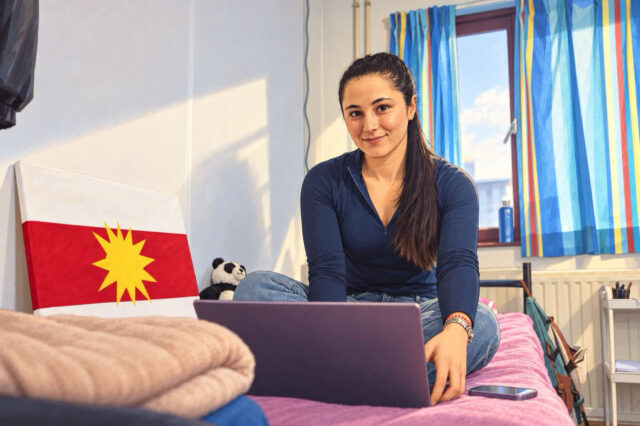
Student Deema Thiban describes how this moment changed the way she understood the role of women among the Ezidi people. Before 2014, she explains, many women lived under social rules that limited their opportunities, particularly when it came to education and work.
“The harsh conditions women experienced during that time made many realise that their role is not only to be mothers or daughters,” she shares. “They discovered they are capable of much more and can create change.”
Watching survivors such as Nadia Murad speak internationally helped her recognise the power of women’s voices. “When I saw Ezidi women sharing their stories and defending their rights, I realised how strong those voices could be.”
A New Awareness
Despite the tragedy, the years after 2014 also brought new awareness among many Ezidi women. The 56-year-old interviewee describes how women began participating more actively in public life, going to markets, attending schools and universities, visiting doctors independently, and connecting more with the outside world.
As she describes it, many women became more aware of their rights and their role in public life. Education among women increased, and many families began encouraging their daughters to pursue studies and careers. For many survivors and young women alike, the future now looks different.
The Future Ezidi Women Envision
Both generations interviewed for this article express hope that the next generation of Ezidi girls will grow up stronger and freer than the one before. The older woman believes that education and confidence will shape the future of Ezidi women. Her hope is simple but powerful: that girls will live without fear and have the freedom to build their own lives with dignity.
Student Deema Thiban shares a similar vision. She hopes that Ezidi girls will refuse silence and never accept limitations placed on their dreams.
“I want them to continue learning, growing, and defending their rights,” she says. “Geography should not limit them. Wherever they are, they can make a difference.”
Beyond Survival
Today, Ezidi women are increasingly visible in politics, education, activism, humanitarian work, and journalism. Many survivors now work with international organisations, document human rights violations, and advocate for justice.
They are no longer seen only as victims of violence. They have become leaders among the Ezidi people.Their voices helped the world understand the genocide against the Ezidi people, and their efforts continue to shape the future of Sinjar and the wider Ezidi diaspora.
The story of Ezidi women is therefore not only a story of tragedy. It is a story of endurance, transformation, and leadership.
As the Ezidi saying goes:
Şêr şêr e; çi jine, çi mêre.
“A lion is a lion, whether male or female.”