
Ezidis in Australia are using the 2026 Census to push for clearer official recognition of their identity, language and religion, with local advocates encouraging families to make sure they are accurately represented in national statistics.
In Coffs Harbour, New South Wales, 16-year-old Bahin A. has been among local multicultural volunteers producing community-language videos explaining the Census in Ezdiki.
Speaking to ABC News, he said the Census was particularly important for Ezidis seeking greater recognition of their identity, religion and language in Australia.
The issue goes beyond simply counting how many Ezidis live in the country. Census data helps determine how different populations are represented in official statistics and can influence how governments and institutions understand the communities living in Australia.
Ezidis must currently write in their religion
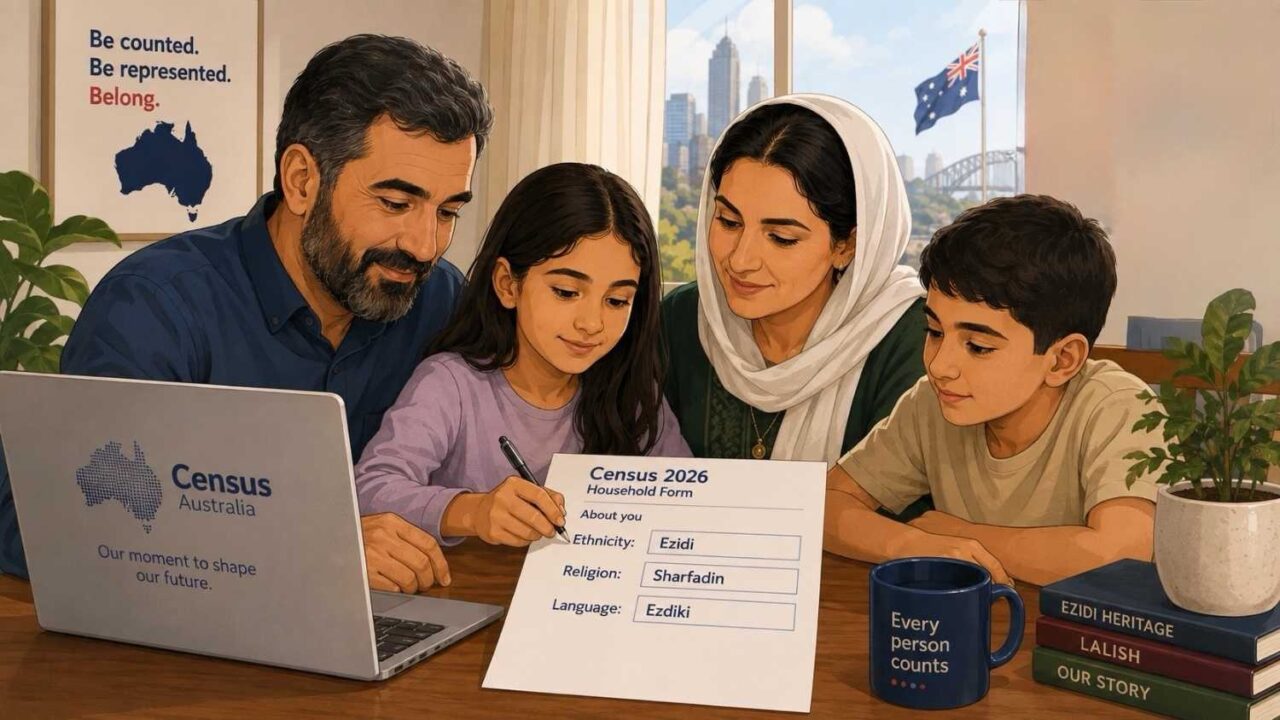
The Australian Census records the religion under the spelling “Yezidi”, but it is not included among the main religion tick-box options. Instead, Ezidis must select “Other” and write their religion in the space provided.
Local Ezidi representative Sami S. has been advocating for Ezidis to receive their own Census option and for the population to be more clearly recognised across questions concerning identity, language and religion.
Speaking to ABC News, she said the aim was for Ezidis to be properly recognised and counted, adding that advocacy and education would continue so that the Australian government could gain a clearer picture of how many Ezidis live in the country.
Ezidi Times uses the spelling Ezidi, refers to the Ezidi language as Ezdiki, and to the traditional Ezidi religion as Sharfadin.
Australia’s recorded Ezidi population has grown
The number of people recorded under the relevant Census category increased considerably between 2016 and 2021.
According to the figures cited by ABC News, 63 people were recorded in 2016, compared with 4,123 in the 2021 Census.
The increase reflects, in part, the arrival of Ezidi families in Australia following the ISIS genocide and subsequent refugee resettlement.
Coffs Harbour is among the Australian regional centres where Ezidi families have established new lives.
ABC News also documented an Ezidi family completing the Census together, showing how younger family members can play an important role in helping parents and relatives understand and complete official forms.
Why recognition matters
For smaller populations, the way Census questions are designed can have a major effect on whether they are properly counted.
When a people, language or religion does not appear among the listed options, respondents must know which alternative category to select and how to write their answer. Differences in spelling or terminology can make smaller populations harder to identify accurately in official statistics.
For Ezidis, this is particularly important because Ezidi identity cannot be reduced to religion alone. Ezidis are a distinct people with their own history, traditions, Ezdiki language and Sharfadin faith.
Advocates in Coffs Harbour are therefore seeking recognition that reflects the different parts of Ezidi identity rather than recording Ezidis only as members of a religious group.
The Census campaign comes during the same period in which Ezidis across Australia have been commemorating the genocide that began with the ISIS attack on Sinjar on 3 August 2014.
Twelve years later, recognition remains important not only in remembering the genocide, but also in ensuring that Ezidis are accurately represented in the countries where they have rebuilt their lives.
Despite this promising step towards improving the representation of Ezidis in Australia, a clearer distinction would be achieved by recording Ezidi as the ethnicity and Sharfadin as the religion. Separating the two would help prevent future confusion over Ezidi identity and ensure that ethnicity and faith are represented accurately in official records.