
A German-based initiative is working to restore damaged agricultural land in Sinjar in an effort to help Ezidi families rebuild their lives and return to their ancestral homeland.
Sister Makrina Finlay of the Benedictine Abbey in Dinklage and German landscape and reforestation expert Volker Kranz are behind efforts to regenerate areas devastated by years of destruction, displacement and environmental damage.
Their work grew out of the Benedictine sisters’ support for Ezidis who arrived in Germany after the genocide committed by ISIS in 2014. Since 2015, the abbey in Dinklage has reportedly accommodated and supported more than 200 Ezidis during asylum proceedings, including through church asylum.
Through those relationships, Sister Makrina heard repeatedly about the desire of displaced Ezidis to return to Sinjar.
That led to a different question: could restoring the land itself make return more possible?
Restoring land destroyed by war and displacement
The environmental damage in Sinjar extends far beyond destroyed buildings.
According to a report by German broadcaster Bremen Zwei, wells were filled in or contaminated, villages and agricultural areas were destroyed, and land that had once supported orchards, grain fields and gardens was left severely degraded.
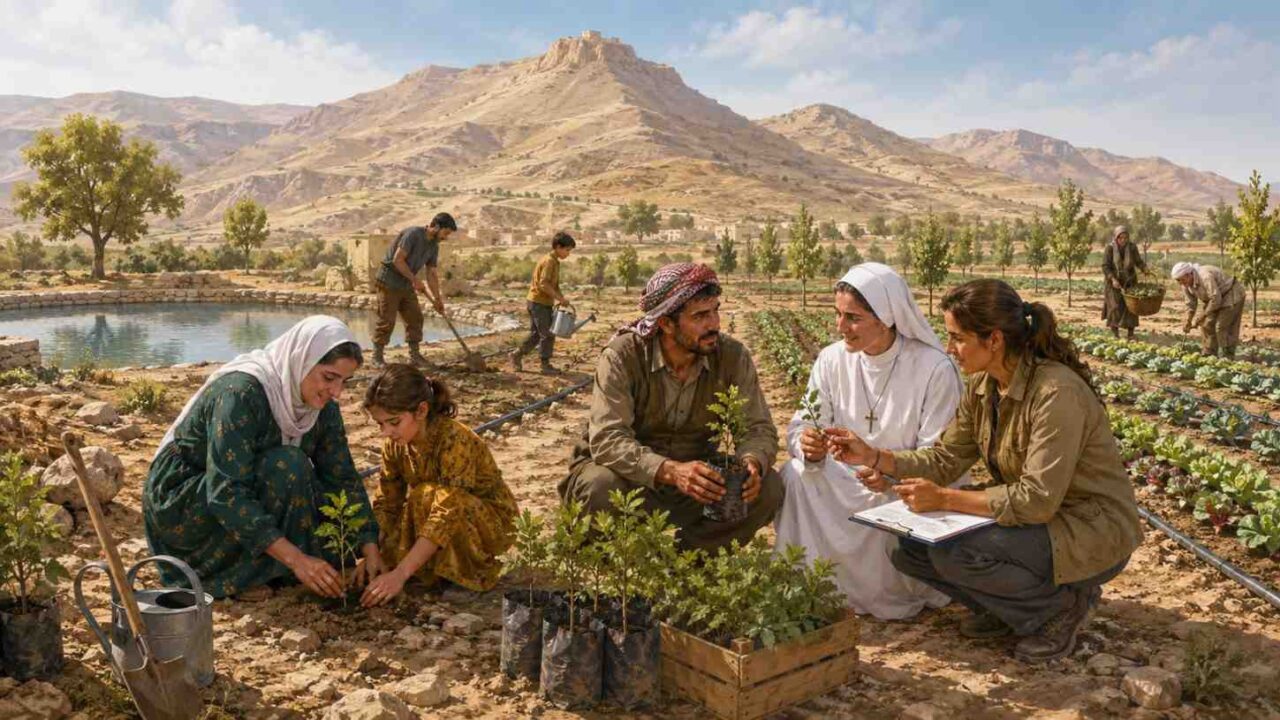
Sister Makrina and Kranz began exploring ways to restore the area through sustainable agriculture and reforestation.
Students assisted for approximately two years in studying which methods could work under the difficult environmental conditions. Their approach focuses particularly on planting resilient trees and collecting rainwater.
The project uses an agroforestry model in which trees provide shade and protection for vegetables and other crops growing between them.
An Ezidi family has returned to farm the land
With support from the organisation Regenerate Shingal e.V., a small farm has already been rebuilt in Sinjar.
An Ezidi family that had been displaced has returned and is now cultivating the farm successfully. The project is intended to serve as an example that could eventually be reproduced elsewhere.
A tree nursery is also being developed to grow and multiply native, fast-growing species suitable for the area.
The long-term ambition is much larger: to help restore vegetation across parts of the Sinjar Mountains and surrounding plains so that the land can once again support families who wish to return.
For Sister Makrina and those involved in the project, environmental recovery is therefore directly connected to the future of Ezidis in Sinjar.
Twelve years after the genocide, many Ezidis remain displaced and unable to return permanently because of insecurity, destroyed infrastructure and limited economic opportunities. Projects that restore farmland and create sustainable livelihoods address one of the practical conditions necessary for return.
The work of Regenerate Shingal offers a different form of reconstruction: not only rebuilding houses, but restoring the land on which future Ezidi life in Sinjar depends.