
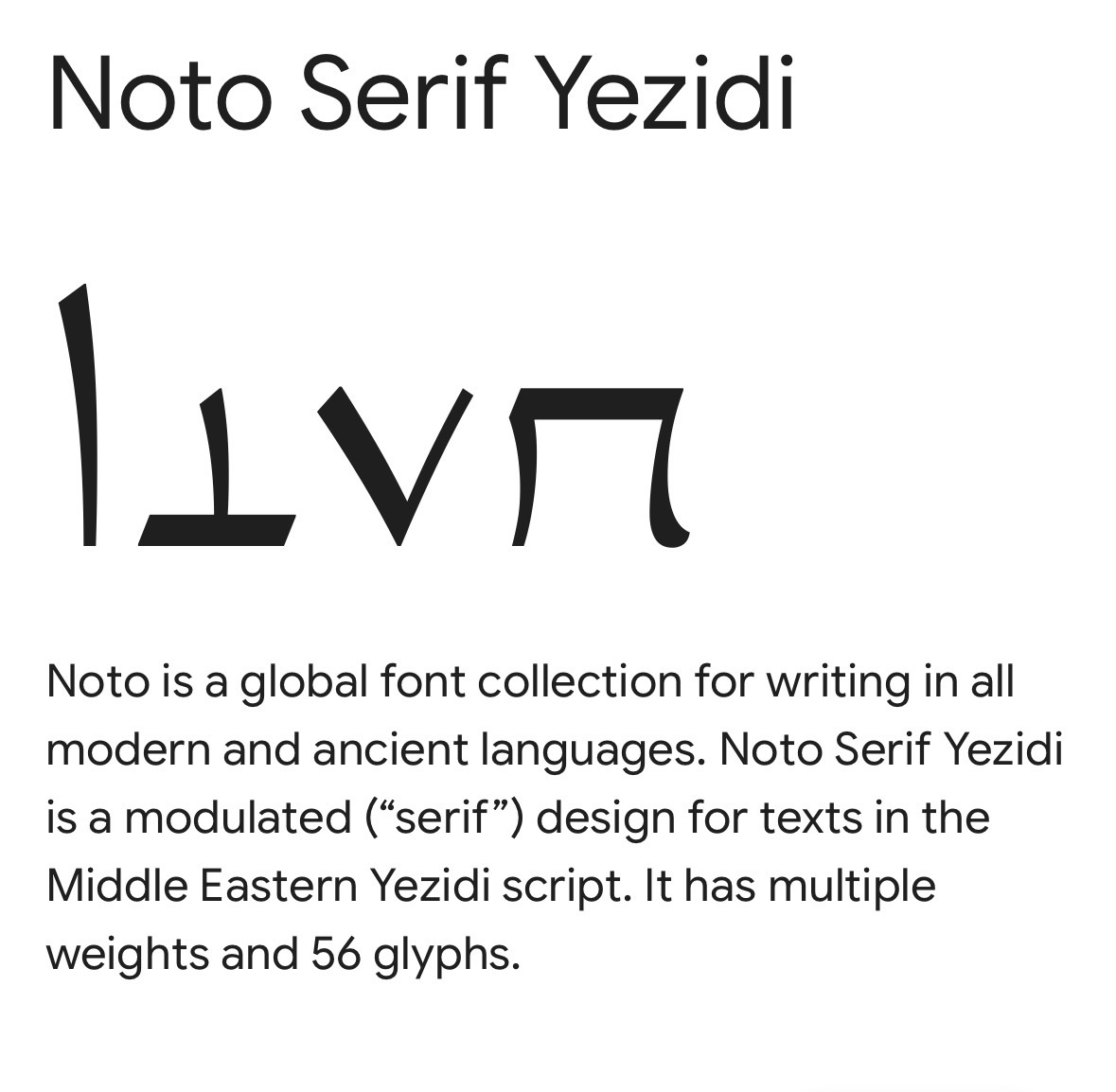
The preservation of Ezidi heritage does not only depend on books, archives and oral tradition. In the modern world, it also depends on whether the Ezdiki script can be written, displayed and shared through digital tools.
One important development is the availability of a dedicated serif font for the Ezidi script through Google’s Noto font project. Noto is a global font collection created to support writing systems from around the world, including scripts that are often underrepresented in digital spaces.
Ezidi Times encourages writers, educators, designers and cultural organizations to explore digital tools that support the Ezidi script. Fonts such as this can help make Ezidi heritage more visible in education, publishing, archives and online media.
A font can become part of cultural preservation. It allows a script to appear properly on websites, in documents, in educational material, in social media graphics, in books and in digital archives. Without such tools, even historically significant scripts risk becoming invisible in everyday digital life.
The Ezidi script is connected to the cultural and spiritual heritage of the Ezidi people and the Sharfadin faith. Making it usable on modern devices helps strengthen access, visibility and continuity. It also gives educators, writers, researchers, publishers and cultural institutions a practical way to include the script in their work.
The serif style gives the script a formal and editorial appearance, making it suitable for cultural articles, academic projects, archive material, book design and visual identity work. Because the font includes different weights, it can be used for both headings and longer texts, depending on the project.
Another important aspect is that the font is available under an open font license. This means it can be used in many types of projects, including public, educational, cultural and commercial work, as long as the license terms are respected. For smaller Ezidi initiatives, this matters because it removes financial and technical barriers.
Digital tools cannot preserve a culture alone. But they can make preservation easier. They help people write, teach, publish and design in ways that reflect their own heritage.
For a people whose history has often been shaped by persecution, displacement and attempts at erasure, visibility matters. The ability to use the Ezidi script in modern publishing is not a small detail. It is part of the wider effort to protect memory, language, faith and identity for future generations.
What is this font in practice?
This font is a digital typeface that allows the Ezidi script to be displayed properly on computers, websites, design programs and printed material. In simple terms, it works like Times New Roman, Arial or Georgia — but it includes support for the Ezidi script.
People can use it for:
Ezdiki educational material
Cultural posters and social media graphics
Books, PDFs and archive documents
Websites and online articles
Research projects and digital preservation
Logos, headings and editorial design
It is especially useful for people who want the Ezidi script to appear clearly and professionally instead of being shown as missing boxes or unsupported characters.
How to download it
1. Go to Google Fonts.
2. Search for the official font name: Noto Serif Yezidi.
3. Open the font page.
Click Download family.
A ZIP file will be downloaded to your computer.
4. Open the ZIP file and install the font files.
On Mac, double-click the font file and press Install Font.
On Windows, right-click the font file and choose Install.
5. After installation, open Word, Pages, Photoshop, Canva, InDesign or another program and choose the font from the font list.
Important note
To write in the Ezidi script, this font alone is not always enough. The user may also need a keyboard layout, text input tool or copyable Ezidi-script text. The font makes the script visible, but the computer still needs a way to type the correct characters.