
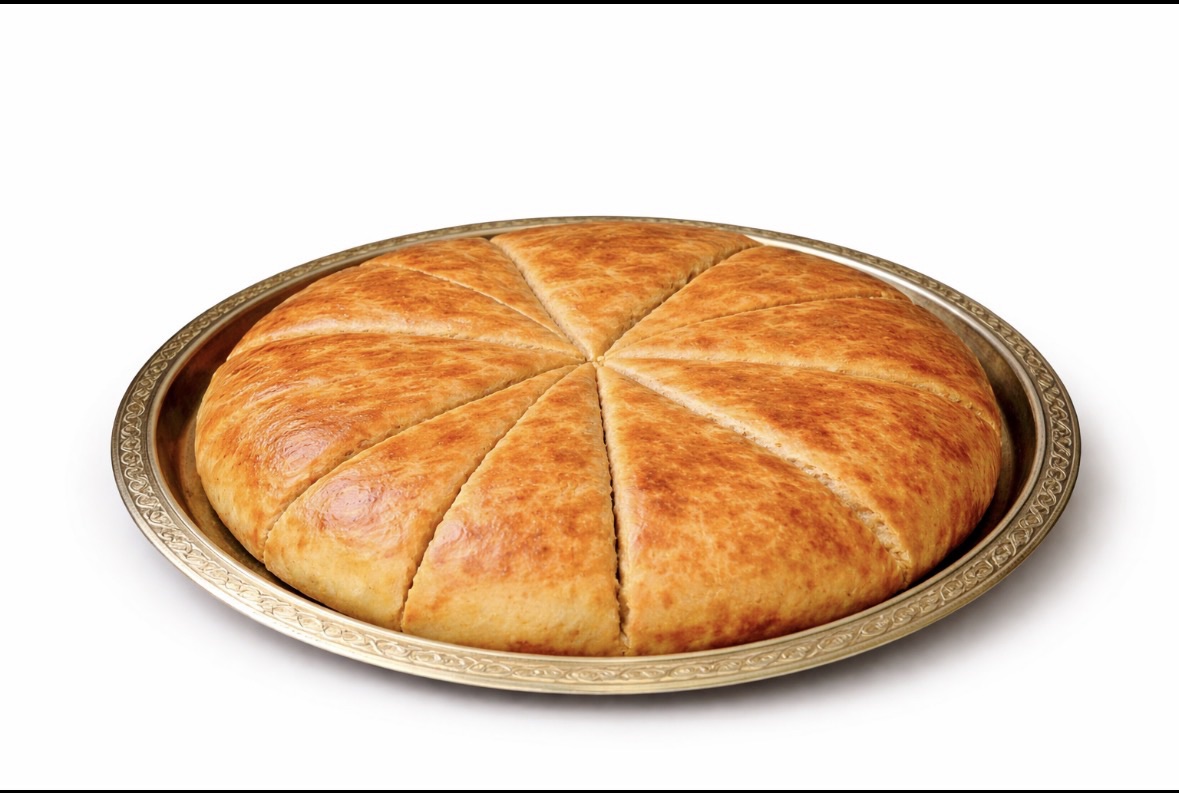
Klocha Sare Sale (Клоча саре сале), often referred to as the “New Year* cake,” is a distinctive tradition preserved among Ezidis from the former Soviet Union. It reflects both the spiritual depth of Sharfadin and the cultural continuity of Ezidis originating from the historical Sarhad region.
While Ezidis share a number of canonical religious holidays, there are also traditions that are specific to certain groups. Klocha Sare Sale is one such example, closely connected to broader Ezidi beliefs, yet uniquely shaped by regional history and diaspora experience.
* Note that previously, the tradition of kloch was celebrated with the Ezidi New Year in April but nowadays it has become a separate celebration.
A Tradition Rooted in Faith and Season
The celebration takes place in March, according to the eastern (Julian) calendar, specifically on the first Wednesday–Thursday of the month of Adar. The timing reflects both a religious and seasonal transition, marking renewal and the awakening of nature.
A similar concept exists among Ezidis in Iraq, where the January festival Belinda is observed. During that time, bread is baked with a single raisin hidden inside. When divided, the person who receives the raisin is believed to carry blessing and fortune for the household in the coming year. Although the timing and details differ, both traditions express a shared symbolic connection between sustenance, blessing, and destiny.
The Ritual of the Cake 🥮
The preparation begins on Tuesday (in some families Wednesday), when the woman of the household bakes a special festive cake or bread. Inside, a small object (typically a bead, pearl or coin) is placed.
Early the next morning, the entire family gathers. The head of the household begins the ritual with the sacred invocation:
“Dastûrî navê Xwedê û Şêxadî”
He then makes the first cut across the middle of the cake. This act is called xeta cot—the “furrow of the plough”—symbolizing cultivation, fertility, and the beginning of a new cycle.
One half of the cake is divided into portions dedicated to sacred beings and spiritual protectors.
The second half is cut into pieces corresponding to each family member, with names spoken during distribution. The person who receives the piece containing the hidden bead or coin is believed to be especially blessed in the coming year, with their fortune influencing the prosperity of the household.
Spiritual Meaning
Within Sharfadin, this tradition carries a deeper metaphysical dimension. It is believed that during this time, God sends the angel Malak Zayn to earth to bless it, after which the world begins to “adorn itself”—a poetic expression of spring’s arrival.
The symbolism of the ritual—cutting the cake like a plough marking the earth—connects spiritual blessing with agricultural fertility. It reflects a worldview in which divine will, nature, and human life are closely intertwined.
A Living Heritage
Klocha Sare Sale remains a powerful expression of Ezidi identity. It preserves ancient beliefs while adapting to new environments, especially among Ezidis who have lived for generations outside their ancestral lands.
Source: Yezidi Sarhad