
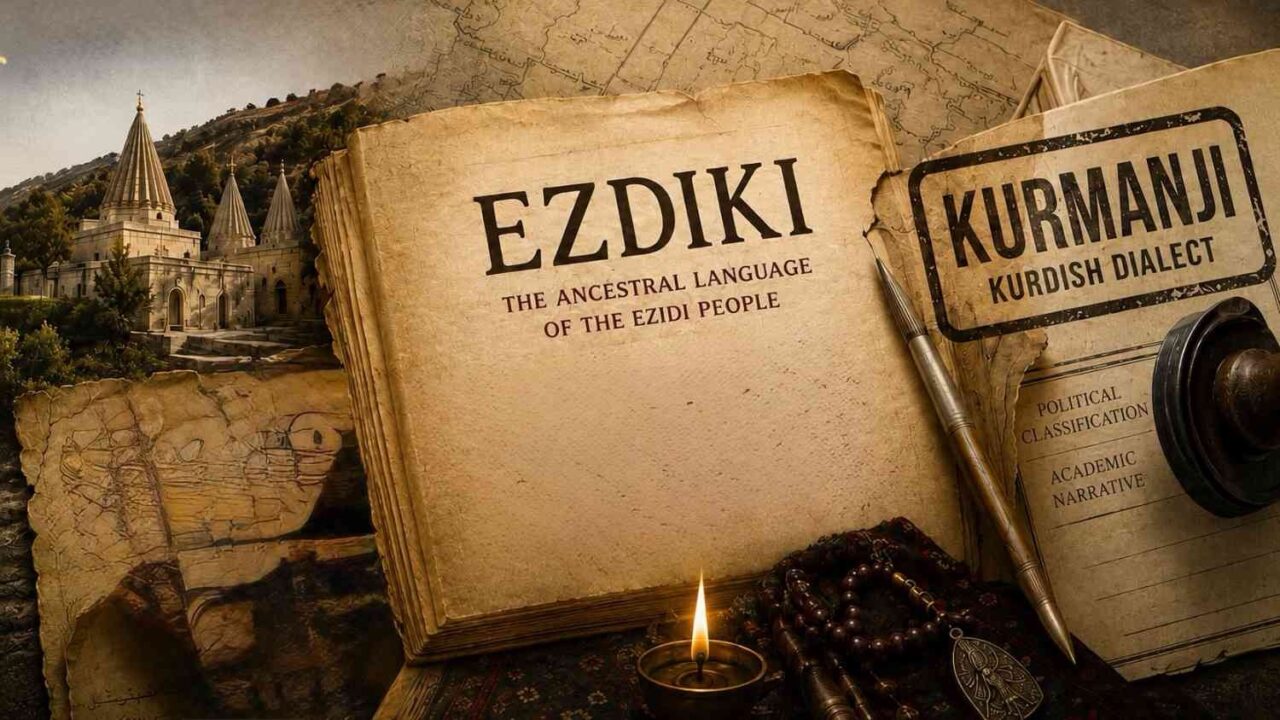
Ezidis are not Kurds. They are a distinct ethnic and religious people indigenous to Mesopotamia, with their own religion, historical memory, traditions, social structures and understanding of who they are. This identity does not become Kurdish because most Ezidis traditionally speak Ezdiki, because Ezidis and Kurds have lived near one another or because Kurdish political movements benefit from counting Ezidis as part of a larger Kurdish population.
The attempt to classify Ezidis as Kurds is not a harmless disagreement over terminology. It affects how Ezidis are represented politically, how their history is taught, how their land is described and who is allowed to speak on their behalf. It reduces an independent people to a religious subgroup of another nation and turns Ezidi identity into something that Kurdish politicians, institutions and academics believe they have the authority to define. They do not.
Ezdiki Predates the Kurdish National Narrative
Most Ezidis traditionally speak Ezdiki, while many Ezidis from Bashiqa and Bahzanê speak Arabic as their first language. Both populations are equally Ezidi because language does not determine ethnicity. Arabic-speaking Ezidis do not become Arabs because they speak Arabic, just as Arabic-speaking Assyrians do not become Arabs and Irish people do not become English because they speak English. Language can change through geography, education, political pressure, migration and contact with neighbouring peoples while ethnic identity remains intact.
Ezdiki was originally spoken by the Ezidi people alone. It existed as the language of Ezidis before the emergence of Kurds as a consolidated people and long before modern Kurdish nationalism attempted to gather different populations, languages and histories beneath a single Kurdish identity. Ezdiki was not borrowed from Kurds, nor did it become Ezidi through contact with Kurdish populations. It was preserved by Ezidis through sacred qewls, prayers, religious terminology, oral traditions and collective memory.
Outside linguists and Kurdish institutions frequently classify Ezdiki within what they call “Kurmanji,” one of the language varieties spoken by populations identified as Kurdish. That classification may describe linguistic similarities, but it does not prove that every person who speaks a related language belongs to the same ethnic group. Linguistic similarity is not ethnic ownership.
The claim that Ezidis must be Kurds because they speak “Kurmanji” depends on a circular political argument. Kurdish institutions first classify Ezdiki as Kurdish and then use that same classification as evidence that Ezidis themselves are Kurdish. The conclusion is built into the classification from the beginning. The language is declared Kurdish because Kurdish nationalism claims the Ezidi people, and the Ezidi people are then declared Kurdish because their language has already been labelled Kurdish. That is a political use of language classification.
The populations now described collectively as Kurds do not descend from one homogeneous people. Kurdish identity was formed through the incorporation of different indigenous populations, tribes and ethnic groups, many of whom were forcibly converted to Islam at different stages of history. Over time, these populations were brought together beneath a broader Kurdish political identity despite having different origins, histories and languages.
This is reflected in the linguistic reality. Kurds do not speak one language divided into minor regional dialects. Populations identified as Kurdish speak several distinct languages, including Kurmanji, Sorani, Zazaki, Gorani, Hawrami, Kalhori and others. These languages differ in grammar, vocabulary, pronunciation and historical development. Calling all of them merely “dialects” of one Kurdish language is not an innocent or neutral classification. It serves the political effort to create the appearance of one ancient, homogeneous and linguistically unified Kurdish nation.
These languages should be studied independently and seriously rather than automatically placed beneath a Kurdish label. Researchers should not blindly accept classifications promoted by Kurdish politicians, nationalist academics and institutions seeking to engineer a unified Kurdish national identity. Political nation-building must not replace honest linguistic and historical research.
The same method has been used against Ezidis. Ezdiki is taken from its Ezidi context, renamed as a Kurdish dialect and then used as evidence that Ezidis belong to the Kurdish nation. This reverses the historical relationship and transforms a political claim into supposed linguistic proof.
Ezdiki belongs to the Ezidi people regardless of how external institutions categorise it. The language carries Ezidi religious hymns, prayers, oral traditions, collective memory and expressions formed within Ezidi society. Kurdish nationalists cannot take a language originally spoken and preserved by Ezidis, label it exclusively Kurdish and then use that imposed label to claim the people themselves.
A language may later be shared, adopted or linguistically related to other languages without one people gaining ownership over everyone who speaks it. Ezdiki remains the ancestral language of the Ezidi people, and Kurdish political movements do not acquire ownership over it by renaming it.
Ezidi Identity Is Not for Kurdish Politicians to Assign
Identity begins with how a people recognises itself. It is formed through history, religion, memory, traditions, persecution, social organisation and collective belonging. Neighbouring populations, governments and political parties do not acquire the right to redefine a people simply because they possess greater institutional power.
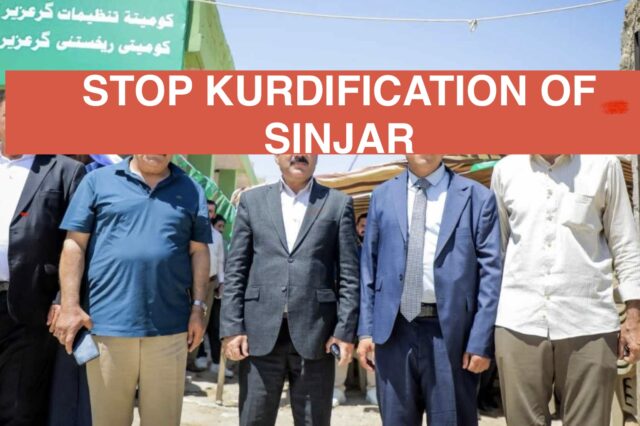
Kurdish nationalist parties have repeatedly counted Ezidis as Kurds when Ezidi numbers strengthen Kurdish demographic claims, territorial ambitions and political influence. Ezidis are presented as Kurds when Kurdish parties want to claim Ezidi-populated areas, speak on behalf of Ezidi survivors or increase the population represented under a Kurdish national label.
The same institutions react very differently when Ezidis demand independent representation, defend Ezdiki as their language or reject being classified as a Kurdish religious subgroup. Ezidis who speak in their own name are then accused of creating division, weakening Kurdish unity or serving the interests of Kurdish political opponents.
The contradiction is obvious. Ezidis are embraced as Kurds when their population, land, votes and suffering are politically useful. They are treated as disloyal when they refuse to surrender their identity. This is not belonging but rather an aggressive political absorption.
A genuinely shared national identity would not require Ezidis to fight for the right to call themselves Ezidi. It would not silence independent Ezidi organisations, reduce Sharfadin to a Kurdish religious tradition or present party-aligned figures as representatives of the entire Ezidi people. It would not treat independent Ezidi political thought as a threat.
Ezidi identity cannot be assigned by the Kurdistan Democratic Party, other Kurdish parties, the Kurdistan Regional Government, foreign researchers or political institutions in Europe. It belongs exclusively to Ezidis.
Political Classification Has Made Ezidis Invisible
For years, international organisations, media outlets and political institutions frequently described Ezidis as a “Kurdish-speaking religious minority.” That description placed the Kurdish label first and reduced Ezidi identity to religion.
The result was political invisibility. Ezidis were discussed as part of a larger Kurdish population instead of being recognised as an indigenous ethnic and religious people with their own political, cultural and security needs.
When a people are placed beneath another national identity, the larger political group is allowed to speak for them. Their land becomes part of someone else’s territorial argument. Their population becomes part of someone else’s demographic statistics. Their representatives are selected or filtered through someone else’s political institutions.
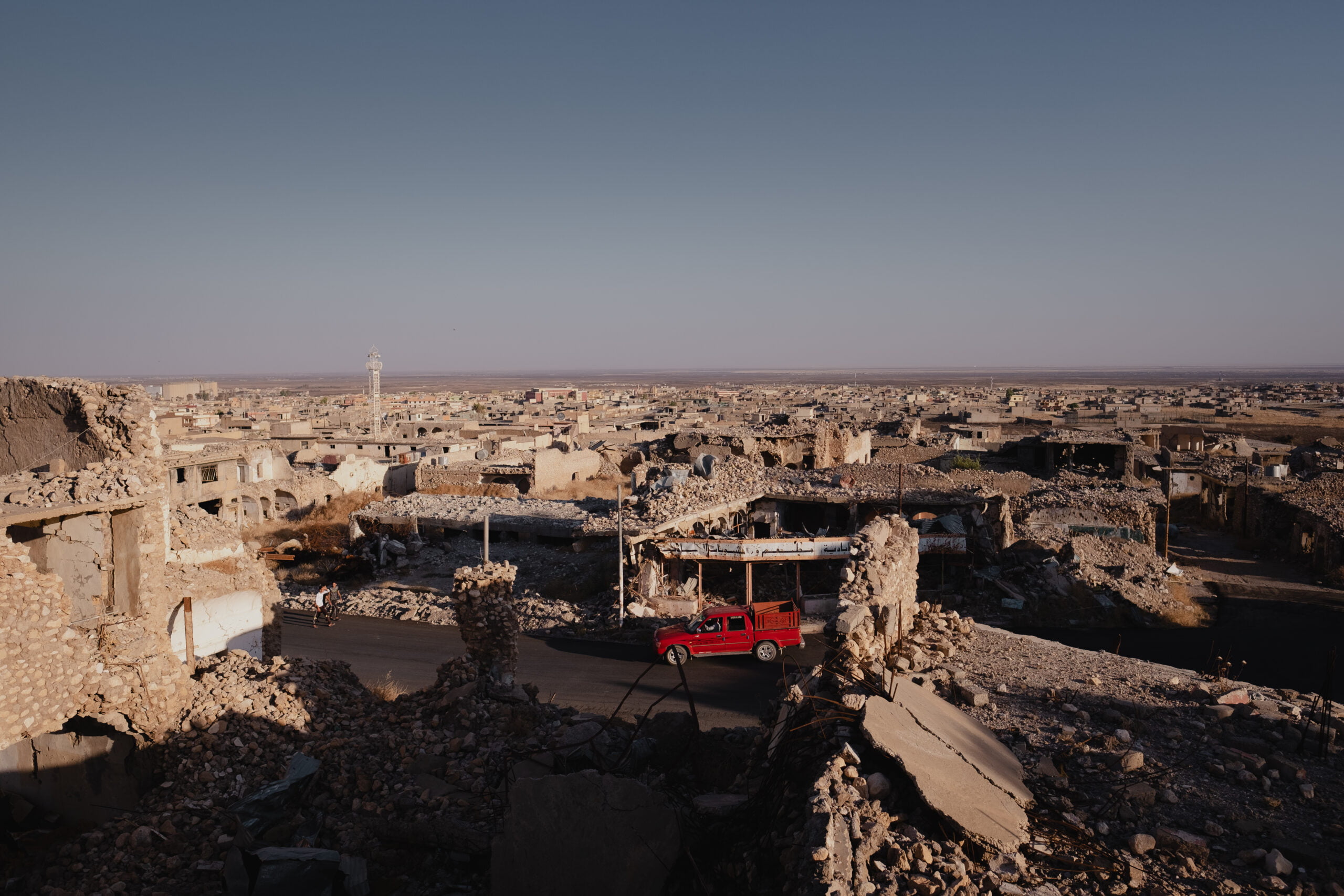
This system became especially destructive before the 2014 Ezidi Genocide. Ezidis in Sinjar were presented as part of the Kurdish population, while Kurdish parties exercised political and security control in the area. Yet when ISIS attacked on 3 August 2014, the Kurdish forces responsible for security withdrew, leaving the Ezidi population exposed.
After the genocide, the same political forces continued to present themselves internationally as the natural representatives and protectors of Ezidis. Ezidi suffering was used in speeches, conferences and diplomatic campaigns while independent Ezidi voices continued to struggle for recognition.
A political movement cannot claim ownership over a people, fail to protect them and then continue speaking in their name as though nothing happened. The genocide forced the world to learn the Ezidi name, but even then, Ezidis were repeatedly described through Kurdish political terminology. A genocide specifically targeting Ezidis should have ended the habit of hiding them beneath another identity. Instead, the struggle over who has the right to define and represent Ezidis continues.
Kurdish Curricula Teach Political Identity as Fact
The attempt to absorb Ezidis into Kurdish identity is also carried through education. School materials used under Kurdish regional authorities have presented Ezidis as unquestionably Kurdish and Sharfadin as an ancient Kurdish religion. This is not an innocent academic interpretation. It teaches Ezidi children that their people do not possess an independent identity and that their religion belongs to Kurdish national history.
When a schoolbook states that there is “no doubt” Ezidis are Kurds, it closes the discussion before Ezidi history, oral tradition or self-identification is even considered. It gives political institutions the authority to decide what Ezidi children must believe about themselves. That is not education but rather identity engineering.
Ezidi children should learn about their people through Ezidi history, Ezidi religious knowledge and Ezidi voices. They should not be taught that their ethnic identity has already been decided by a political system that benefits from counting them as Kurds.
Academic and educational institutions do not become neutral simply because they use the language of history or research. Scholarship can also serve political nationalism, especially when it repeatedly centres the claims of the dominant group while dismissing the self-definition of the people being studied. Researchers who begin with the assumption that Ezidis are Kurds usually interpret every shared word, custom and geographic connection as evidence of Kurdish identity. At the same time, distinct Ezidi religion, sacred traditions, social structures and historical memory are treated as secondary differences. The conclusion is decided before the research begins.
Sharfadin Is the Religion of the Ezidi People
Sharfadin is not an ancient Kurdish religion, a Kurdish denomination or a surviving branch of Kurdish culture. It is the religion of the Ezidi people. It has its own theology, sacred hymns, rituals, religious classes, holy places, spiritual authorities and understanding of creation. It shapes Ezidi collective life, religious belonging, marriage traditions, moral responsibilities and continuity across generations.
For Ezidis, religion and peoplehood cannot be separated in the way Kurdish nationalist narratives attempt to separate them. Ezidis are not simply Kurds who happen to follow another religion. Sharfadin has preserved Ezidi identity through centuries of persecution, forced conversion and repeated fermans directed specifically against the Ezidi people.
Calling Sharfadin a Kurdish religion transfers ownership of Ezidi sacred heritage to Kurdish nationalism. Ezidi hymns become Kurdish folklore. Ezidi religious figures become Kurdish historical figures. Ezidi holy places become evidence of Kurdish territorial antiquity. Ezidi traditions are then displayed as parts of Kurdish culture while the people who preserved them are denied the right to stand independently. This is cultural and religious appropriation.
Kurdish institutions cannot claim Ezidi sacred heritage while rejecting independent Ezidi identity. They cannot display Ezidi clothing, music, religious symbols and historical figures as Kurdish culture and then accuse Ezidis of division when they object. Sharfadin belongs to Ezidis. Its sacred hymns, religious traditions and spiritual heritage are not raw material for Kurdish national branding.
Shared Customs Do Not Make Two Peoples One
Ezidis and Kurds have lived in neighbouring areas for generations. Shared geography naturally produces similarities in food, clothing, music, vocabulary and daily customs. Similarities also exist between Ezidis and Arabs, Assyrians, Armenians and other peoples of Mesopotamia.
Kurdish nationalist narratives use shared culture selectively. When Ezidi clothing resembles clothing worn by Kurdish populations, it is declared Kurdish. When Ezidi music uses Ezdiki, it is declared Kurdish. When Ezidi traditions resemble those of neighbouring peoples, the similarities are presented as proof that Ezidis belong to a Kurdish nation.
The distinct parts of Ezidi culture are then dismissed as merely religious. Under this method, every similarity proves that Ezidis are Kurdish, while every difference is treated as irrelevant. That is not serious cultural analysis. It is a system designed to reach one predetermined conclusion.
Ezidi culture must be named as Ezidi culture. Clothing worn and preserved by Ezidi women is Ezidi clothing. Sacred music transmitted through Ezidi religious tradition is Ezidi religious heritage. Ezidi festivals, oral narratives and social customs belong to the Ezidi people. Neighbouring peoples can share cultural elements without one claiming ownership over the other.
Kurdish Nationalism Cannot Demand What It Denies Ezidis
Kurdish people have experienced persecution, forced assimilation and denial of their identity across several states. Kurdish political movements have correctly argued that speaking Turkish, Arabic or Persian does not erase Kurdish identity and that governments have no right to impose another national label on Kurds. The same principle applies to Ezidis.
Kurdish nationalism cannot condemn Arabisation, Turkification and Persianisation while practising the same logic against Ezidis. A political movement cannot demand self-determination for Kurds while denying Ezidis the right to define themselves. The struggle of Kurdish people does not grant Kurdish parties ownership over Ezidi identity. Suffering does not create the right to absorb another people.
Ezidis and Kurds can cooperate as neighbours and political allies. Cooperation does not require assimilation. Solidarity does not require one people to disappear beneath the name of another.
Real solidarity begins with equality between two peoples. It requires Kurdish politicians and institutions to stop claiming Ezidis as Kurds, stop using Ezidi population figures for territorial arguments and stop presenting party-aligned individuals as the only legitimate Ezidi representatives. Calling these demands “division” is a political tactic. It shifts responsibility onto Ezidis for refusing to participate in their own erasure. The division begins when one people refuses to recognise the other.
The Ezidi Name Does Not Require a Prefix
Ezidi collective memory speaks of 74 fermans—campaigns of persecution, forced conversion, displacement and destruction directed against the Ezidi people. Ezidis survived because they preserved their religion, traditions, collective boundaries and identity under extreme pressure. Their survival was not achieved by disappearing into another people.
The name Ezidi carries its own history, religion and meaning. It does not require the label “Kurdish Ezidi,” “Ezidi Kurd” or “Kurdish religious minority” to become legitimate.
Academic debates about ancient populations and linguistic relationships will continue. Those debates cannot override the identity of a living people. No scholar has greater authority over Ezidi identity than Ezidis themselves.
Ezidis are a distinct ethnic and religious people indigenous to Mesopotamia. They are not a Kurdish subgroup, and Sharfadin is not a branch of Kurdish religion. Kurdish politicians, educational institutions and nationalist academics must stop treating Ezidi identity as territory they are entitled to claim. The right to define Ezidis belongs to Ezidis alone.