
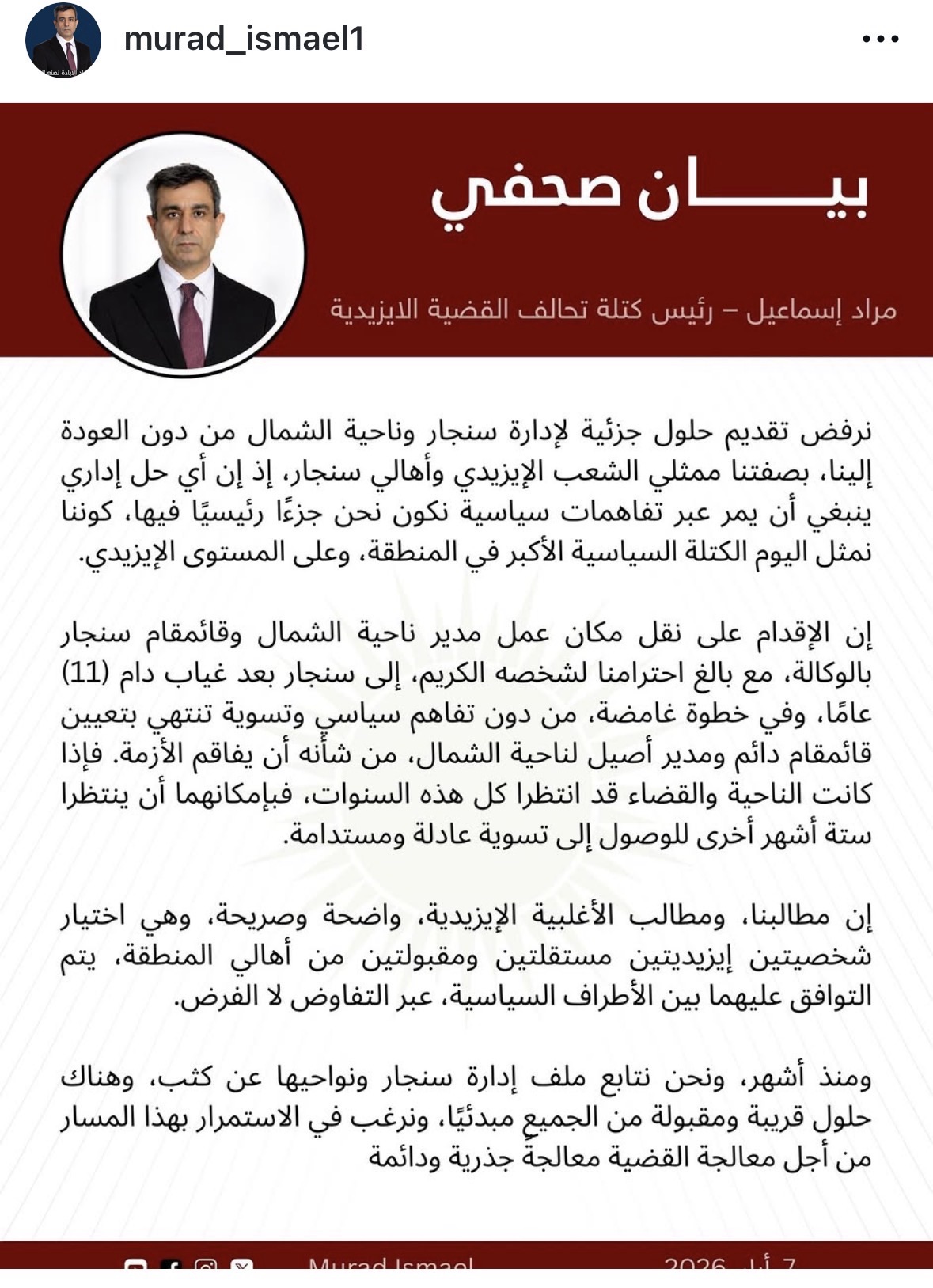
The [Yazidi Cause Alliance] has issued a strong official statement rejecting any attempt to return the KDP and its party, security, administrative, or intelligence apparatus to Sinjar.
Following recent criticism and allegations that Murad Ismael, one of the most prominent figures of the [Yazidi Cause Alliance], was aligning with Kurdish political actors after reported meetings, the Alliance has now issued a forceful official statement clarifying its position.
The statement leaves no room for ambiguity: the [Yazidi Cause Alliance] categorically rejects any return of the KDP to Sinjar and frames such a move as a direct threat to Ezidi security, dignity, genocide memory, and the future of Sinjar.
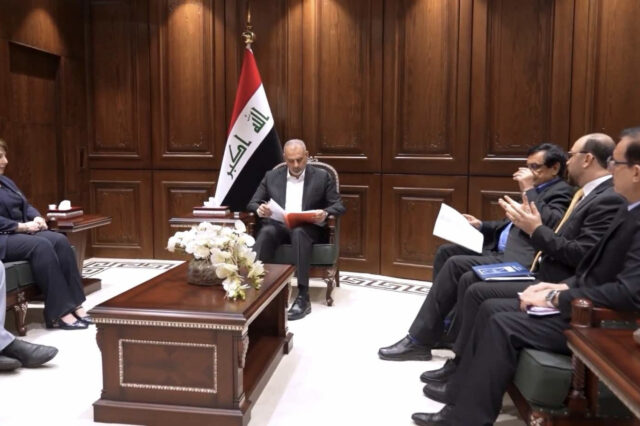
The statement comes amid renewed political movement surrounding the future of Sinjar and after meetings involving prominent Yazidi Cause Alliance leader Murad Ismael with political actors. The Alliance’s message is direct: Sinjar must not be returned to the same political order that existed before the Ezidi genocide of August 3, 2014.
In its statement, the [Yazidi Cause Alliance] declared that the return of the KDP to Sinjar is “categorically rejected.” It described any attempt to restore the pre-genocide status quo as an attempt to deliver a final blow to the security of Sinjar, the dignity of its people, and the memory of its victims.
According to the Alliance, the return of the KDP would not be a normal political or administrative development. Rather, it would represent an early warning of renewed repression, arbitrary arrests, intimidation, assassinations, silencing of dissent, and the imposition of party will by force.
The Alliance stated that the KDP bears political, security, moral, and historical responsibility for the policies that paved the way for the genocide of the people of Sinjar. It said this responsibility began after 2003, when the party took control of the district, deployed armed and security forces, established party offices, and transformed Sinjar into an area under closed party control.
The statement said this control aimed to dismantle the Ezidi national, religious, linguistic, and geographical identity. It accused the party of buying loyalty through salaries and positions, recruiting Ezidi youth into its ranks, co-opting social figures, and opening institutions that appeared cultural but were in reality partisan, including the so-called Lalish Cultural and Social Center.
The Alliance also accused the KDP of targeting Ezidi culture and folklore by attempting to impose foreign alternatives on the Ezidi people. It referred to interference in Ezidi dress, celebrations, folk songs, religious sayings, and sacred verses, as well as the persecution of those who refused to join the party or opposed its policies.
A central part of the statement concerns Ezidi religious life and the sanctity of [Sharfadin]. The Alliance condemned the use of Ezidi religious sites and shrines as party and military headquarters, from Sinjar to Lalish in Sheikhan. It described this as a direct attack on the sanctity of religion and a serious violation of Ezidi spiritual independence.
The statement also addressed the years before the genocide, particularly 2007 and 2009. The [Yazidi Cause Alliance] accused the KDP of pursuing a systematic policy that undermined the social fabric and created tensions between Ezidis and their Arab neighbours through checkpoints, arrests, false accusations, and restrictions on movement.
The Alliance also referred to the bloody attacks against Ezidi civilians, including the August 14, 2007 bombings in Qahtaniyah/Tal Azir and Siba Sheikh Khidri, as well as the August 29, 2009 bombing in Sinjar. It holds the party responsible for the conditions under which these attacks occurred and accused it of using the violence to isolate Ezidis, spread fear, and present itself as the sole protector of Sinjar instead of uncovering the perpetrators and bringing them to justice.
The strongest part of the statement concerns August 2014. The Alliance stated that approximately 10,000 Peshmerga fighters withdrew without resistance, taking their weapons and equipment with them, alongside security and political forces, without warning the civilian population. In the words of the statement, Sinjar and its defenceless people were handed over to ISIS “on a silver platter.”
What followed was the Ezidi genocide: massacres of men and youth, the enslavement of women and children, mass displacement, the siege of Mount Sinjar, and the siege of Kocho. The Alliance cited figures that remain central to Ezidi memory: 6,417 abducted, 1,293 killed at the beginning of the genocide, 95 mass graves, 2,745 orphans, 68 destroyed Ezidi shrines and religious sites, 120,000 refugees, and 400,000 internally displaced persons.
The statement added that Ezidi areas and infrastructure were 80 percent destroyed. Homes, property, livestock, vehicles, and household belongings were looted, burned, or destroyed.
The Alliance also condemned the KDP’s conduct after the genocide. According to the statement, the party did not acknowledge responsibility or accept accountability. Instead, it resorted to intimidation and threats against those who said the party had betrayed Sinjar. The Alliance also accused the party of supporting certain Ezidi armed groups that fought ISIS in order to later claim they were affiliated with the Peshmerga and to deny that Sinjar had been abandoned.
The [Yazidi Cause Alliance] therefore declared three clear positions:
First, it absolutely rejects the return of the KDP to Sinjar in any political, security, administrative, intelligence, or party form, under any pretext or guise. It considers any such step a direct provocation to the families of victims, survivors, displaced persons, missing persons, and all the people of Sinjar.
Second, it warned that the return of the party would reopen the door to arbitrary arrests, persecution, threats, assassinations, political and social revenge, and the silencing of independent Ezidi voices that exposed the truth about what happened in Sinjar.
Third, it warned that any party, tribal figure, social actor, political force, or media outlet that welcomes, promotes, justifies, or provides cover for the KDP’s return will bear full responsibility for the consequences of destabilising Sinjar.
The statement marks one of the clearest and strongest positions issued by the [Yazidi Cause Alliance] on the future of Sinjar. It rejects not only the return of a political party, but the return of an entire system of control that the Alliance says weakened Ezidi identity, interfered in Ezidi religious and cultural life, and failed catastrophically in 2014.
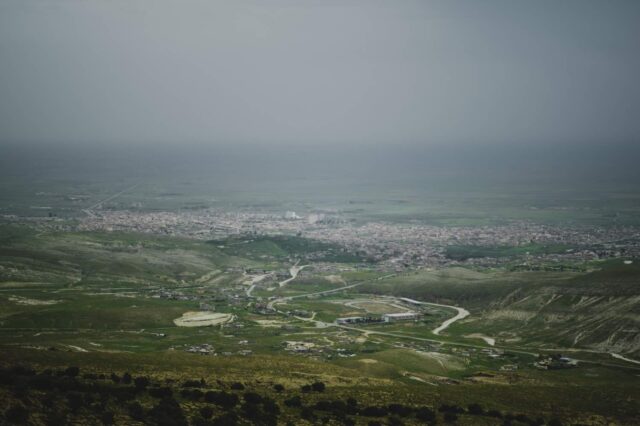
For Ezidis, Sinjar is not merely a district to be negotiated between parties. It is the heart of a genocide. It is the place of mass graves, destroyed shrines, abducted women and children, orphaned families, displaced survivors, and a people still waiting for justice.
The Alliance’s message is therefore clear: Sinjar must not be returned to the forces that controlled it before the genocide. The future of Sinjar must be shaped by Ezidi will, Ezidi security, Ezidi dignity, and accountability for what happened before, during, and after August 3, 2014.
Sinjar must not be returned to the pre-genocide order. Its future must belong to its people.