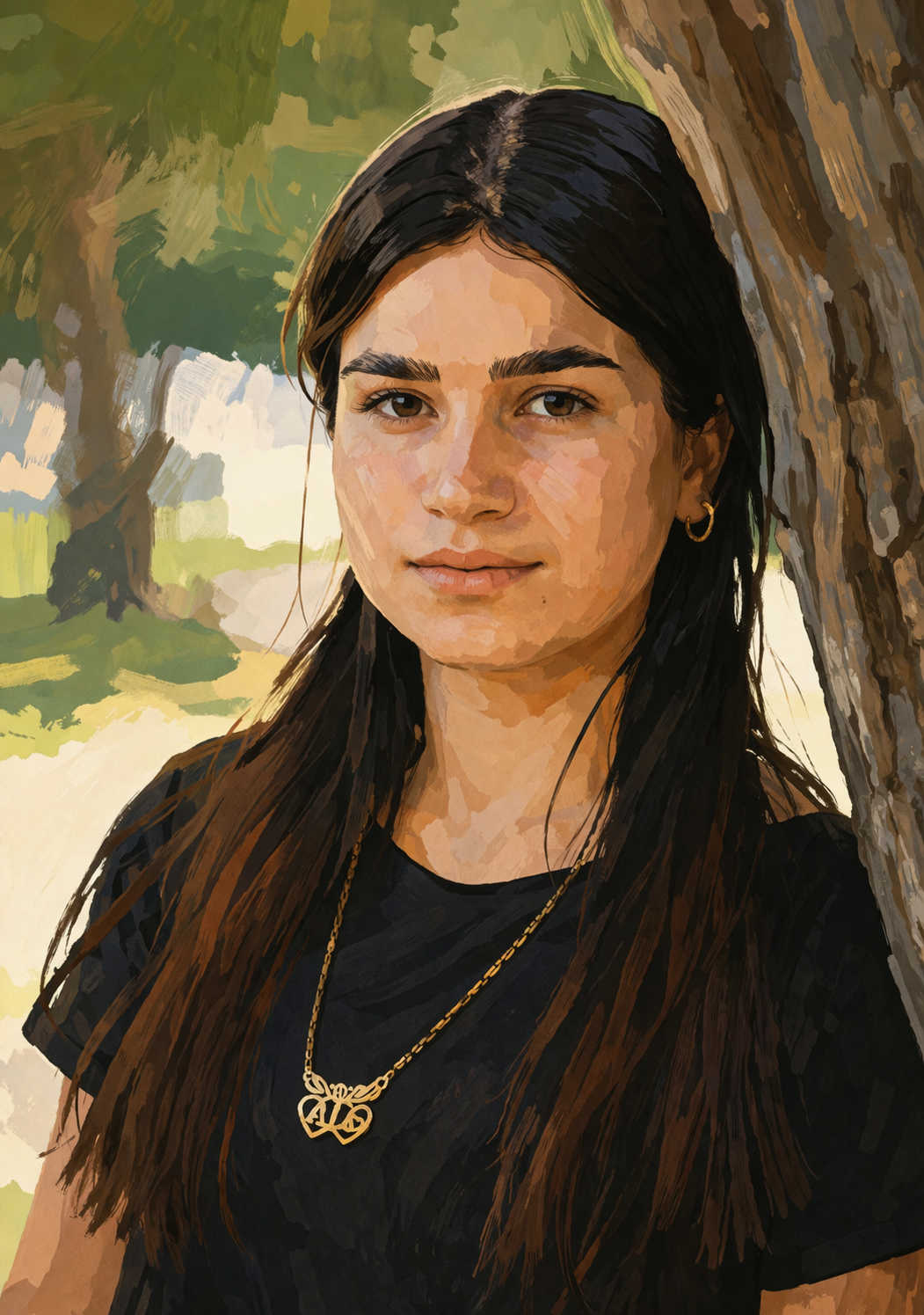
More than a decade after the genocide against the Ezidi people, Amera still carries the memory of the day her life changed forever. She was 11 years old, sitting under her grandmother’s fig tree in Sinjar with her brother Ali, when ISIS arrived in their village.
“I remember everything,” she says. “We were just sitting there. Then suddenly everything changed.”
ISIS fighters ordered families to separate. Women and children were pulled away. That was the last moment she saw her brother.
“He told me, ‘my heart always be with you.’ I never saw him again.”
Amera became one of thousands of Ezidi women and children kidnapped and enslaved. During her captivity, she began writing letters, secretly, often at great risk. What started as a way to cope with fear became a quiet act of resistance.
“I wrote because I was scared, but also because I had hope,” she says. “I believed that maybe one day someone would read my words and understand what ISIS did to us.”
She found pens and paper wherever she could, including in a classroom where she was held with other Ezidi women and children. She hid the letters under desks, inside her clothes, and among her belongings. Even when her mother warned her of the danger, she continued.
“They already did so many bad things to us,” she says. “I wanted to leave something behind.”
At one point, an ISIS fighter caught her writing and burned her letter in front of her. Still, she did not stop.
Amera was moved between locations and later separated from her family for several months. She describes the abuse and fear she endured, including being held in the home of a man who had once lived among the Ezidi people before joining ISIS.
In April 2015, on her 12th birthday, she managed to escape together with others. But freedom did not mean an end to hardship. Her family spent years in refugee camps, struggling with daily survival.
“Those first months were very hard,” she says. “Sometimes even harder than captivity.”
In 2019, her family resettled in Australia. Today, Amera is studying law, while continuing to live with the lasting impact of her experiences. Her recently published book, based on the letters she wrote in captivity, is dedicated to her brother Ali and to all Ezidis who remain missing.
“My focus is to find answers,” she says. “We just need to know the truth. Where is Ali? What happened to him?”
She still returns to the letters she wrote as a child.
“When I read them, I feel like he is next to me,” she says. “Like he is listening.”
Her story is not only about survival, but about memory, justice, and the ongoing search for those who have not yet been found.
Original source: The Guardian, Adeshola Ore, published March 7, 2026.