
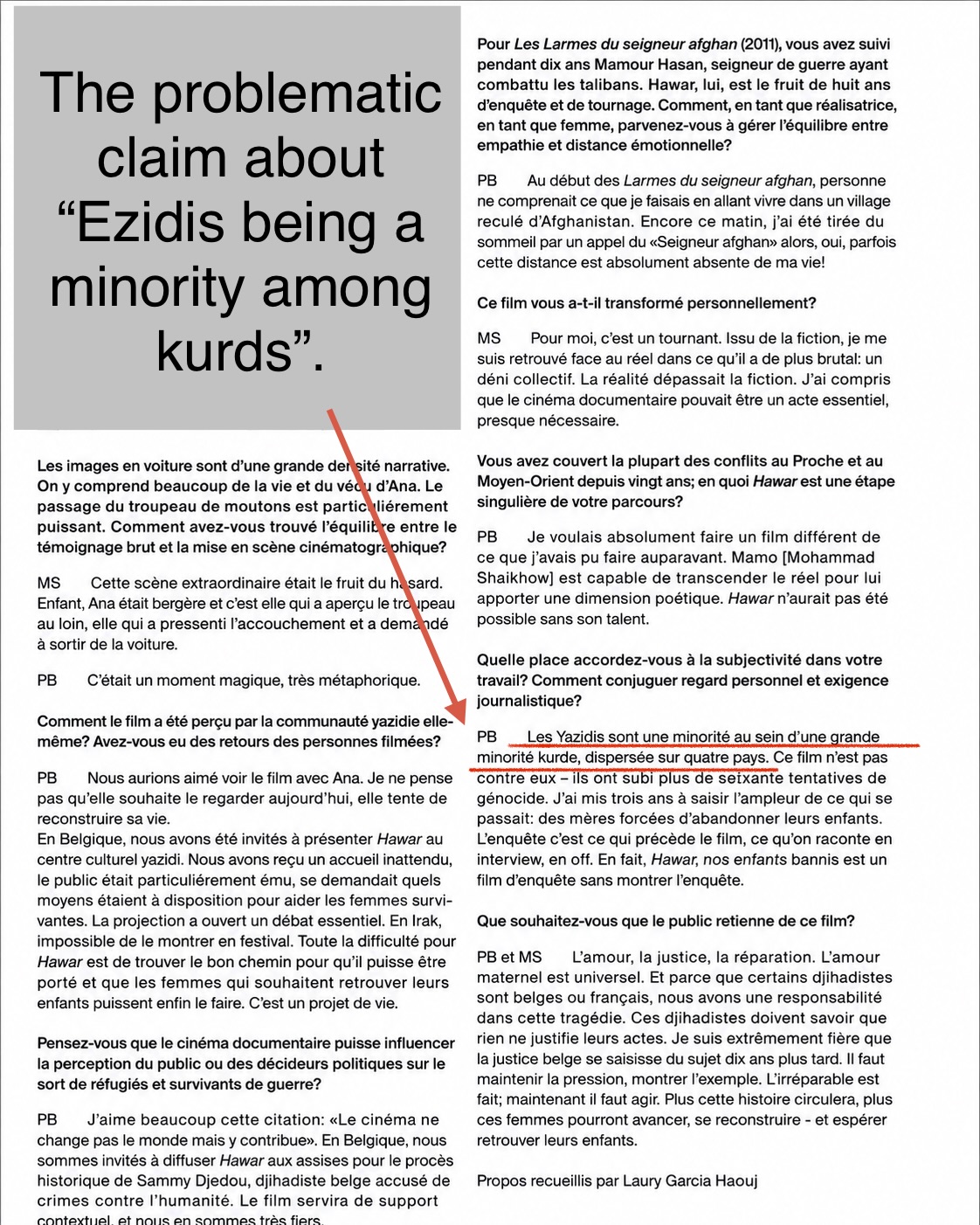
In a published interview about the film Hawar, Our Banished Children, conducted by Laury Garcia Haouj, a sentence appears that should not pass without criticism. Pascale Bourgaux is quoted describing Ezidis as “a minority within a large Kurdish minority, scattered across four countries.”
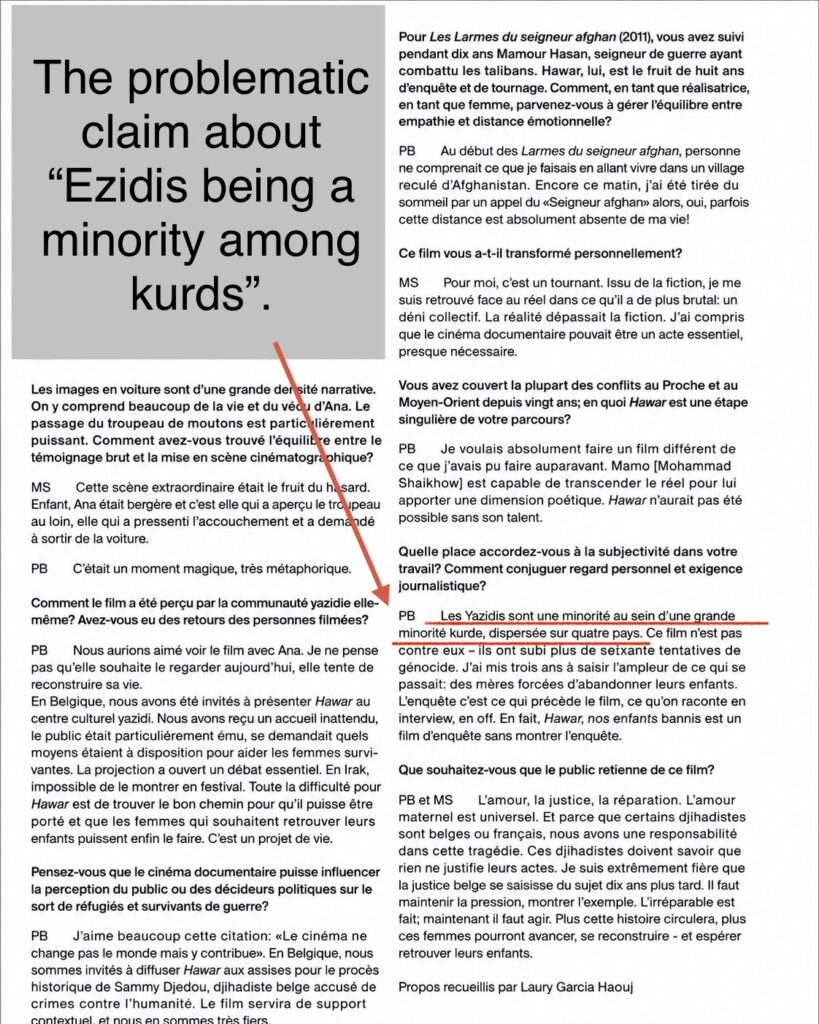
Ezidis are not a “minority within a minority.” Ezidis are an ancient ethno-religious people with their own identity, history, culture, collective memory, and religion, Sharfadin. We are not a branch of another people, not an appendix to another political identity, and not a small cultural detail inside someone else’s national project. We are Ezidis, and that should not be difficult to say.
Calling kurds a “minority” is laughable and insulting to peoples who are actually minorities and actually live under erasure and marginalisation.
A project that claims to address the genocide against Ezidis should not, at the same time, introduce Ezidis through another identity. That is not context. That is distortion. It is deeply insulting to use Ezidi suffering as the emotional and moral centre of a film while still pursuing some hidden kurdish propaganda-agenda.
It places Ezidis inside a larger kurdish framework and teaches the reader to understand Ezidis through someone else. This is how assimilation often works. It does not always arrive openly or aggressively. Sometimes it arrives through soft cultural language, interviews, film descriptions, academic terms, and seemingly innocent sentences that quietly absorb one people into another.
Ezidi women were not targeted by Daesh because they were “kurdish”. Ezidi men were not executed because they were “kurdish”. Ezidi children were not abducted, enslaved, indoctrinated, or separated from their mothers because they were “kurdish”. Ezidis were targeted because they are Ezidis, because of Sharfadin, and because their existence as a distinct people was marked for destruction.
The Professional Moral…doesn’t Exist
If journalists, filmmakers, academics, and cultural institutions want to speak about Ezidi suffering, then the minimum requirement is accuracy. Ezidis do not need to be introduced through anyone else. Our identity is not negotiable, and our genocide should not be used as a platform for language that reduces us to a subgroup of another people. Anyone who claims to tell our story must first understand who we are.
In all honesty, we wish that the genocide never happened to us. We wish that it belonged someone else. If there is any group who desires to be seen as the genocide victims; please, may your wishes come true. But we will never accept cheap propaganda to rename the suffering that our Ezidi peopel went through and label it as “kurdish”. This is an insult to all the victims and their sacred memories.
The sentence should have been simple: Ezidis are an ancient ethnic and religious people whose religion is Sharfadin, and the film addresses the aftermath of the genocide committed by Daesh against Ezidis.
Ezidis are not “a minority within a minority.” Ezidis are Ezidis. And anyone who cannot state that clearly should not present themselves as qualified to explain Ezidi suffering to the world.