

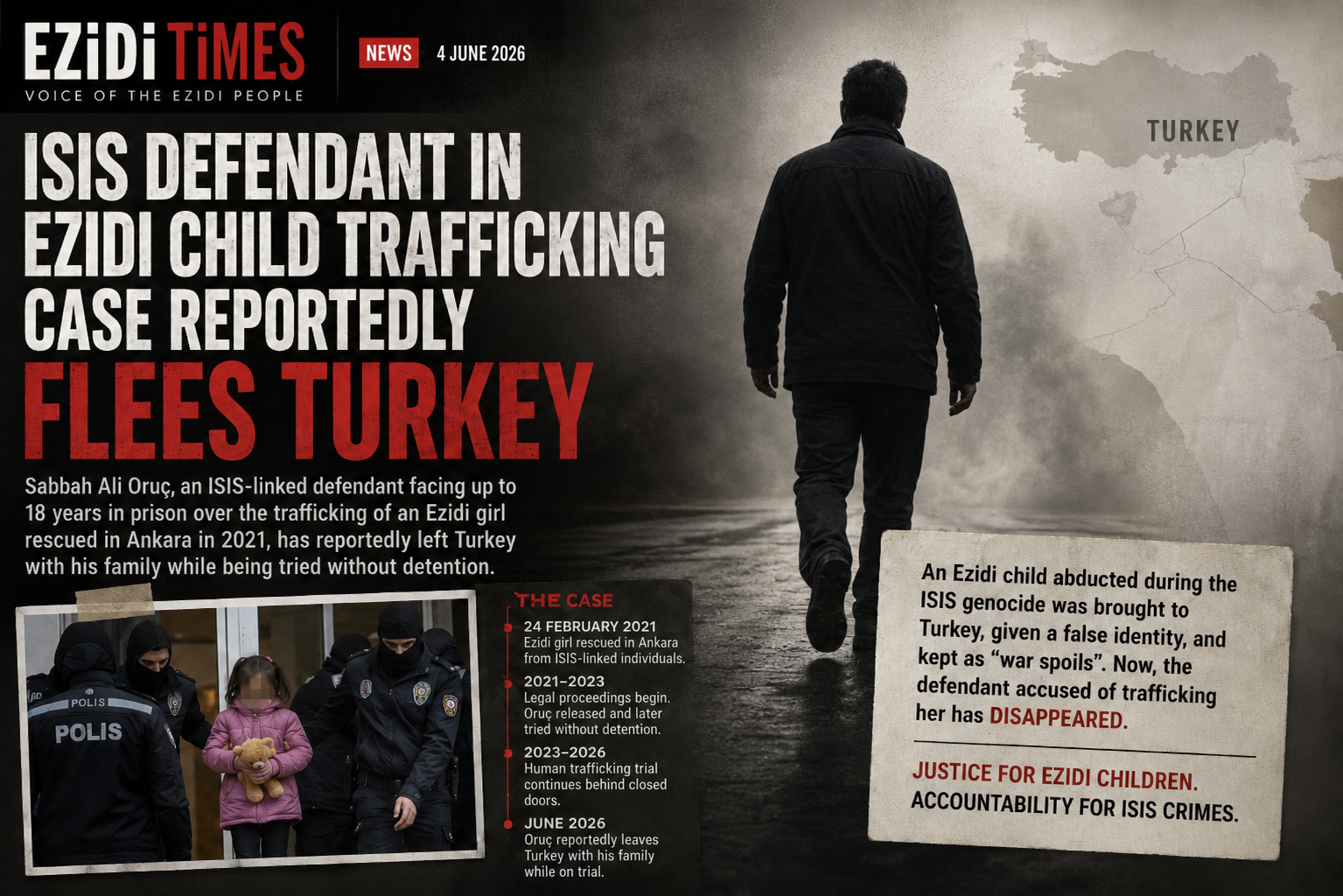
An ISIS-linked defendant who was being tried in Turkey over the trafficking of an abducted Ezidi girl has reportedly left the country with his family, creating a new and serious failure in a case that has already exposed major problems in the protection of Ezidi children rescued from ISIS captivity.
Sabbah Ali Oruç, described in Turkish case reporting as one of ISIS’s Iraqi figures, was being tried without detention on human trafficking charges and faced up to 18 years in prison. His case was considered especially significant because he was among the first ISIS-linked defendants in Turkey to face trial for human trafficking in connection with an Ezidi child abducted during the ISIS genocide.
The case began publicly on 24 February 2021, when Turkish police and intelligence units carried out an operation in the Yenimahalle district of Ankara. During the raid, authorities rescued a seven-year-old Ezidi girl who had been kept in the home of ISIS-linked individuals. At the time, Turkish authorities presented the operation as a rescue from an ISIS network, while reports stated that the child had been taken from Iraq and treated by ISIS as so-called “spoils of war.”
According to statements and case material reported in Turkey, the child had been brought into the household in Iraq in 2014, when she was around two years old. Oruç claimed that his brother had brought the girl home and said that he had bought her from ISIS for 500 dollars. Oruç denied personally kidnapping or buying the child, but the case file raised serious allegations that the girl had been unlawfully taken from Iraq, brought to Turkey and kept inside the family structure of ISIS-linked individuals.
The legal process later revealed further disturbing details. Oruç had reportedly joined ISIS in 2014, acted under the orders of an ISIS military figure in Mosul, received payment from the organisation, used weapons and took part in ISIS-related activities. After being detained in Iraq and later released, he entered Turkey through Syria using a false passport. The Ezidi girl was also brought to Turkey, and an identity document was reportedly obtained for her through false statements, using the name of Oruç’s brother.
Despite the gravity of the allegations, Oruç was released during the earlier proceedings and later continued living in Ankara. A separate human trafficking case was opened after sustained legal efforts by lawyers and human rights organisations. That case was heard in secret due to the sensitivity of the file and the best interests of the child. Now, while that process was still ongoing, Oruç is reported to have disappeared from Turkey with his family.
The development raises a direct question about the Turkish judiciary and state authorities: how was a defendant accused of trafficking an abducted Ezidi child allowed to stand trial without detention and then leave the country? The case does not involve an ordinary criminal allegation. It concerns an Ezidi child taken during the ISIS genocide, brought across borders, held inside an ISIS-linked household and later placed at the centre of a legal battle that should have required the highest level of protection and accountability.
Ezidi Times previously reported on the same case after Turkish authorities controversially granted guardianship of the rescued Ezidi girl to an ISIS-linked family member. That decision was later reversed following public outrage, and a lawyer was appointed to represent the child’s interests. The girl has remained under state protection since her rescue, while legal and international efforts have continued to identify and reach her first-degree relatives.
The reported disappearance of Oruç now adds another layer of injustice to the case. For Ezidis, this is not only about one defendant escaping trial. It is about the repeated failure to treat abducted Ezidi children as victims of genocide, trafficking and enslavement who require full protection under international law. It is also about the failure to ensure that those accused of participating in ISIS crimes cannot simply disappear while survivors and their families continue waiting for justice.
The file that began in Shingal and reached Ankara remains a symbol of the wider struggle for accountability after the ISIS genocide. Ezidi children were not abandoned property, not adopted children of ISIS families, and not objects to be renamed through false documents. They were abducted from their people, their families, their religion and their homeland.
The latest development demands answers. Turkish authorities must clarify how Sabbah Ali Oruç was able to leave the country while facing human trafficking charges, whether an arrest process has been initiated, and what measures are being taken to ensure that the Ezidi girl’s rights, safety and identity remain protected. The fact that an ISIS-linked defendant was released and allowed to leave Turkey freely is not only a disgrace; it shows how Turkey’s justice system continues to enable impunity for ISIS crimes instead of functioning as the justice system of a state governed by the rule of law.