
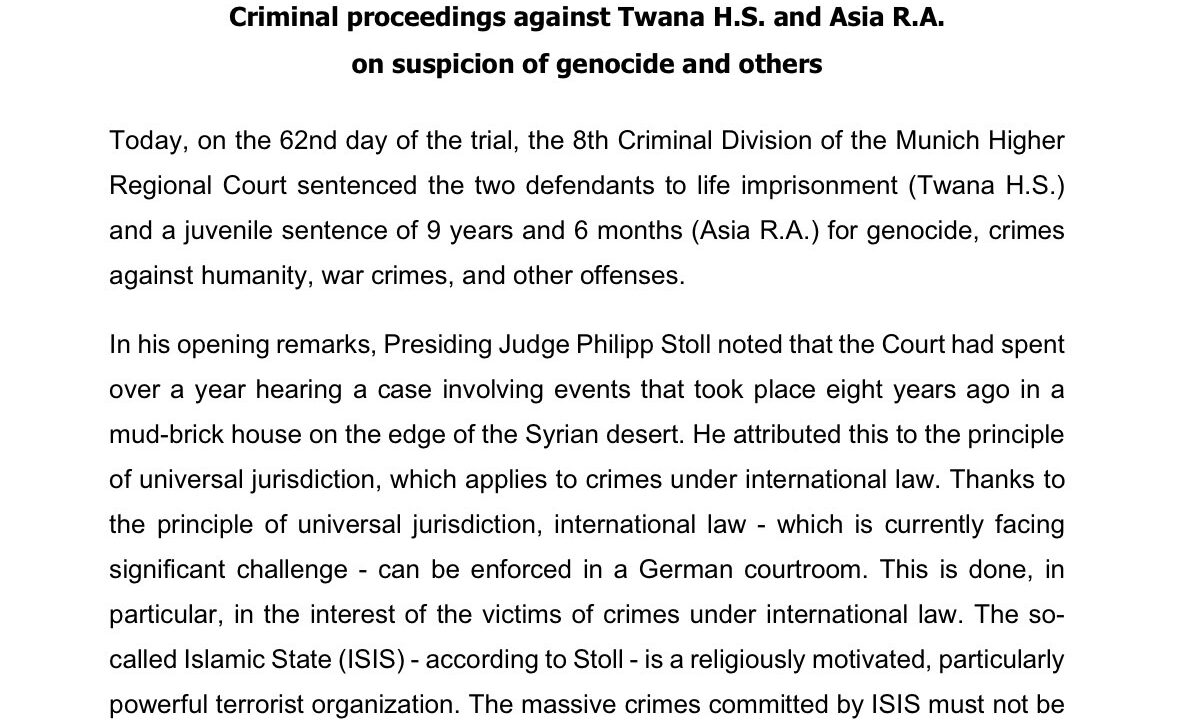
This article provides a preliminary summary of the judgment issued by the Munich Higher Regional Court, based on the court’s official press release. Ezidi Times will publish a more comprehensive legal analysis of the case shortly, including further verified information about the perpetrators, the evidence presented during the proceedings, the crimes committed against the two Ezidi girls and the wider legal significance of the judgment.
The Higher Regional Court of Munich has convicted two Iraqi ISIS members of genocide, crimes against humanity, war crimes and multiple other offences committed against two Ezidi girls in Iraq and Syria.
On 13 July 2026, following 62 days of hearings, the court sentenced Twana H.S. to life imprisonment. Asia R.A. received a juvenile sentence of nine years and six months, close to the maximum sentence available under the juvenile criminal law applied in her case.
The proceedings concerned crimes committed between 2015 and 2017, when the defendants lived under ISIS control, first in Iraq and later in Syria. Twana H.S. served as an ISIS fighter, while Asia R.A. was aware of his role and managed their shared household.
The judgment is particularly significant because the court expressly recognised that ISIS committed genocide against the Ezidi ethnic group. The court also referred to the Ezidi religious community, acknowledging the ethnic and religious character of the Ezidi people rather than describing Ezidis only as a religious minority.
ISIS’s planned destruction of the Ezidi people
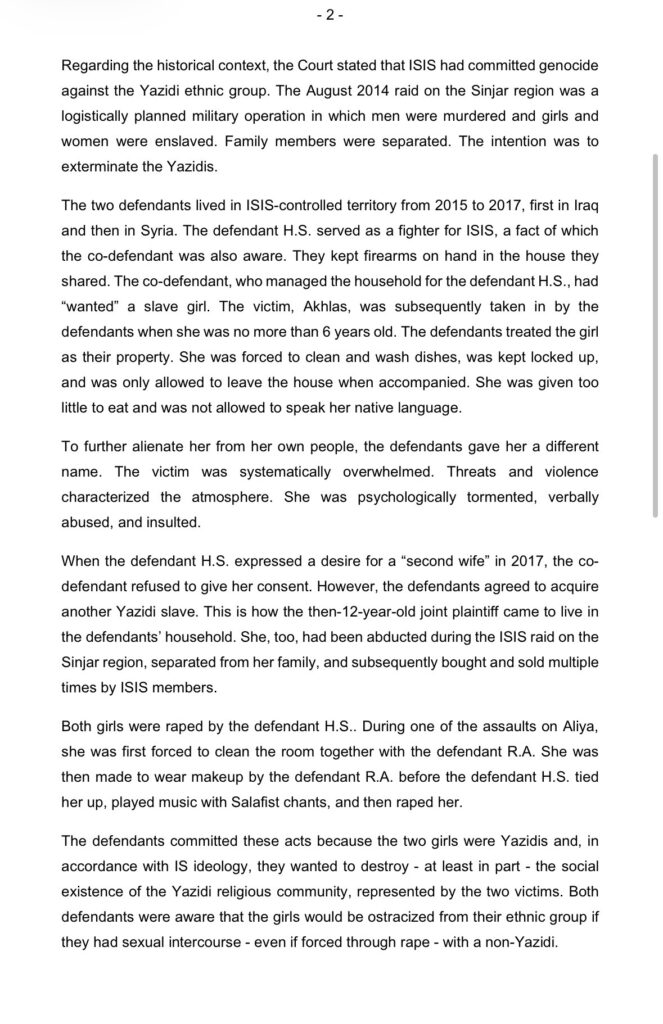
In explaining the historical context, the court described ISIS’s August 2014 attack on Sinjar as a planned military operation intended to destroy the Ezidi people.
During the assault, Ezidi men were murdered, women and girls were abducted and held in captivity, and families were deliberately separated. The court concluded that the purpose of the operation was the extermination of the Ezidis.
The defendants were not convicted for the crimes of ISIS generally, but for their own personal participation in the genocidal campaign.
The case was prosecuted in Germany under the principle of universal jurisdiction. This principle permits German courts to investigate and prosecute genocide, crimes against humanity and war crimes committed abroad, even when the offences did not take place in Germany.
A six-year-old Ezidi girl treated as property
The first victim, identified as Akhlas, was no more than six years old when she was brought into the defendants’ household.
According to the court’s findings, Asia R.A. had wanted an enslaved girl in the household. The defendants subsequently took possession of Akhlas and treated her as their property.
The child was forced to clean the house and wash dishes. She was kept locked inside and was permitted to leave only when accompanied. She received insufficient food and was prohibited from speaking her native language.
The defendants also gave her a different name as part of an effort to separate her from her identity and her people.
She was subjected to threats, violence, verbal abuse and severe psychological torment. The court found that she was systematically overwhelmed and placed in an atmosphere dominated by fear.
A second Ezidi child brought into the household
In 2017, Twana H.S. expressed his intention to take a second wife. Asia R.A. refused to accept this, but the defendants instead agreed to acquire another Ezidi girl.
The second victim, who participated in the proceedings as a joint plaintiff, was approximately 12 years old when she entered the defendants’ household.
She had been abducted during the 2014 ISIS attack on Sinjar, separated from her family and repeatedly bought and sold among ISIS members before reaching the defendants.
Both children were raped by Twana H.S.
During one of the assaults against the 12-year-old survivor, Asia R.A. first made the child clean the room with her. She then applied makeup to the girl before Twana H.S. tied her up and raped her while playing Salafist chants.
The court found that Asia R.A. supported and facilitated the sexual violence.
Crimes committed because the victims were Ezidis
The court determined that the defendants committed these crimes because the girls were Ezidis.
Their actions were connected to ISIS ideology and intended to contribute to the destruction of Ezidi social and religious existence. The two children were not targeted randomly; their Ezidi identity was central to the defendants’ treatment of them.
The defendants also understood that sexual violence could further isolate the girls from their own people. They were aware that the victims risked social exclusion because they had been subjected to sexual intercourse with non-Ezidis, even though it occurred through rape.
This finding is legally important because it demonstrates how rape, forced captivity, renaming, language prohibition and separation from family were used not merely as individual forms of abuse, but as instruments intended to destroy Ezidi identity and social continuity.
Both girls were sold by Twana H.S. in late November 2017.
The court stated that they continue to suffer severely from the crimes, including post-traumatic stress disorder.
Testimony from Ezidi survivors
Neither defendant directly addressed the allegations during the trial.
The court nevertheless found the crimes proven after examining extensive witness testimony and expert evidence.
Particular importance was placed on the testimony of the joint plaintiff, who gave evidence over several days, as well as testimony from other Ezidi women. Some travelled from other continents to appear before the court.
The court also heard evidence from a woman who had returned from ISIS territory and had witnessed both girls being held in the defendants’ household.
Asia R.A.’s request for forgiveness from one of the victims during the proceedings was considered alongside statements she made to a psychiatric expert.
Despite this request for forgiveness; reports from the courtroom state that the two perpetrators showed nothing but disdain towards the victim.
Genocide, crimes against humanity and war crimes
The court classified the defendants’ conduct as genocide and as crimes against humanity involving:
- enslavement;
- torture;
- sexual violence;
- persecution;
- deprivation of liberty;
- and the infliction of severe psychological harm.
The conduct was also classified as war crimes involving cruel or inhuman treatment and sexual violence.
Additional convictions included aggravated sexual abuse of children, complicity in aggravated sexual abuse and membership in a foreign terrorist organisation.
The court found no reason to depart from the life sentence prescribed for genocide in the case of Twana H.S.
Why juvenile law was applied to Asia R.A.
Asia R.A. was sentenced under juvenile criminal law after the court consulted a psychiatric expert.
The court considered her personal history, which included the early death of her mother, her father’s imprisonment and an early first marriage. It concluded that it could not be ruled out that her emotional and psychological development remained comparable to that of a juvenile when the offences began.
The court also considered that she had shown some signs of remorse and understanding.
However, because of the extraordinary seriousness of the crimes and their continuing consequences for the victims, she was sentenced to nine years and six months. The sentence is close to the maximum juvenile sentence of ten years.
Recognition of Ezidis as an ethnic group
The court’s wording is fundamentally important for the Ezidi people.
Ezidis are often reduced in political, media and institutional language to a religious minority. Such terminology fails to acknowledge Ezidis as a people with a shared ethnic identity, history, culture, traditions, collective memory and connection to ancestral lands.
The Munich court explicitly stated that ISIS committed genocide against the Ezidi ethnic group. It also referred to the Ezidi religious community when examining the defendants’ intent to destroy Ezidi social and religious existence. The statement is important as it explains that Ezidis are an ethnic group but that the isis members had the genocidal intent with the Ezidi religion (Sharfadin) as motive.
The judgment therefore recognises both dimensions of Ezidi identity: Ezidis are an ethnic people and followers of the Sharfadin religion.
This recognition is especially significant in genocide law, which protects national, ethnic, racial and religious groups. The court acknowledged that the crimes were intended to destroy more than individual victims or private religious beliefs. They targeted the continued existence of the Ezidi people.
Judgment not yet final
The verdict is not yet legally final.
The defence, the Federal Prosecutor’s Office and the joint plaintiffs have the right to appeal to the Federal Court of Justice. An appeal had to be filed within one week of the judgment.
The case represents an important development in the prosecution of international crimes committed against Ezidis. It holds two ISIS members personally accountable, places the testimony of Ezidi survivors at the centre of the legal record and formally acknowledges that ISIS sought to destroy the Ezidis as an ethnic and religious people.