
Historian Dr Rebecca Jinks has dedicated recent years to documenting the lived experiences of Ezidi women who survived ISIS captivity in Iraq, placing their testimonies within a longer historical continuum of genocidal violence against women. Her work draws a deliberate parallel between the Ezidi genocide that began in 2014 and the genocide of 1915, not to collapse their differences, but to illuminate recurring patterns of gendered violence, captivity, and survival across a century.
The starting point for this research was visual. Images published in 2014 of Ezidi women fleeing ISIS captivity immediately evoked earlier archival photographs from the Armenian genocide that Dr Jinks had encountered in her academic work. The resemblance was not merely aesthetic but structural: forced displacement, sexual enslavement, the destruction of family units, and the use of women’s bodies as instruments of genocidal policy. This recognition shaped the direction of her research and underscored the urgency of preserving Ezidi women’s testimonies within a historical framework that acknowledges continuity rather than treating each genocide as an isolated event.
In 2023, Dr Jinks travelled to Iraq with photographer Claire Thomas to collect testimonies directly from Ezidi survivors. Her methodology differed markedly from journalistic or legal approaches. Rather than focusing solely on the period of captivity, she situated each testimony within the broader life history of the women, before, during, and after genocide. This approach reflects an understanding that the genocide did not begin with abduction nor end with escape, but continues to shape every aspect of survivors’ lives.
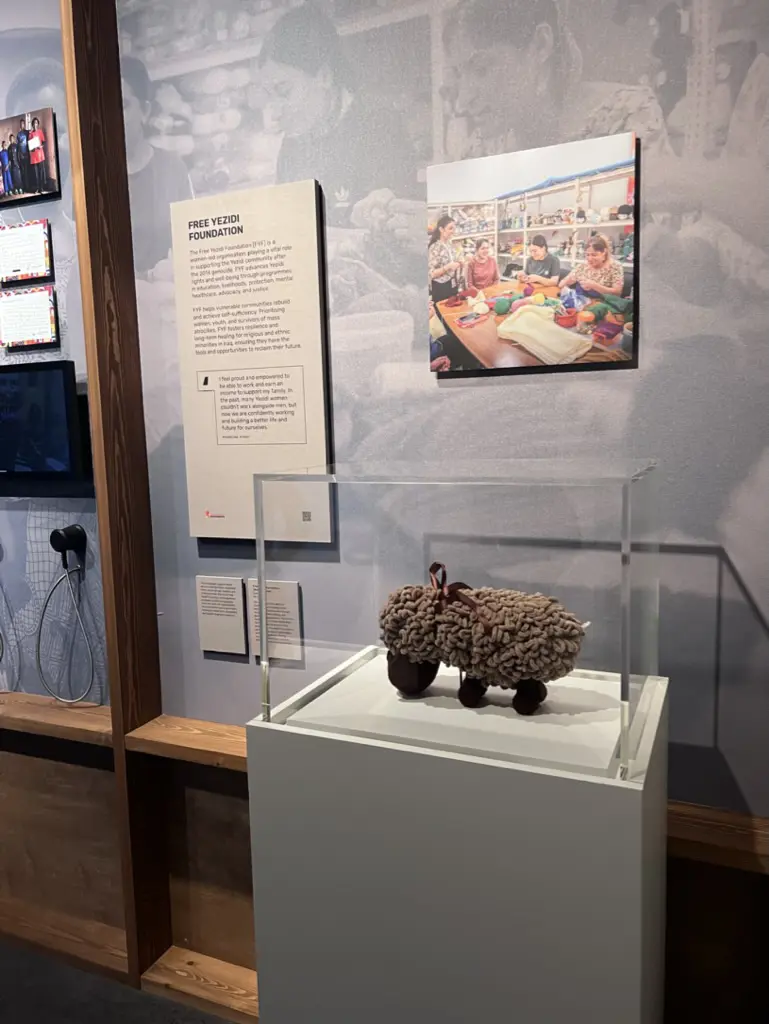
Central to this work was a strong ethical framework. Drawing lessons from early twentieth-century collections of Armenian women’s testimonies—many of which were gathered without clear consent or survivor agency—Dr Jinks prioritised informed, culturally sensitive engagement. Consent was recorded verbally, and interviews were conducted with the support of a trusted translator and psychological professionals. The involvement of the Free Ezidi Foundation was crucial, both in ensuring survivor well-being and in building trust within a population that has repeatedly been subjected to extractive documentation by external actors.
The resulting body of fifteen testimonies has been preserved at the Wiener Holocaust Library in London. In 2024, these testimonies formed the core of the exhibition Genocidal Captivity: Retelling the Stories of Armenian and Ezidi Women. The exhibition reached a broad audience, demonstrating a strong public willingness to engage with complex histories when they are presented through the voices of those who lived them. Visitors encountered not abstract timelines but personal narratives that revealed how genocidal systems operate at the most intimate level.
Elements of this research were later incorporated into a major exhibition on sexual violence in conflict at the Imperial War Museum, significantly expanding its reach. The inclusion of Ezidi testimony in such a setting marked an important shift: Ezidi experiences were not marginal additions but central to understanding modern conflict-related sexual violence and its historical precedents.
Dr Jinks is now preparing a book that weaves together the histories of the Armenian and Ezidi genocides in parallel, alternating chronologically across a hundred-year span. This structure is intended to prompt readers to recognise patterns for themselves, fostering historical awareness that resists the tendency to treat genocide as exceptional rather than systemic.
For Ezidi Times, this work is significant not only as an academic contribution but as an act of preservation. Ezidi women’s voices, grounded in their own narratives and supported by ethical scholarship, are being secured within global historical memory. At a time when denial, distortion, and silence continue to threaten the truth of the Ezidi genocide, such documentation plays a vital role in ensuring that Ezidi suffering, resilience, and survival are neither forgotten nor detached from their historical meaning.