
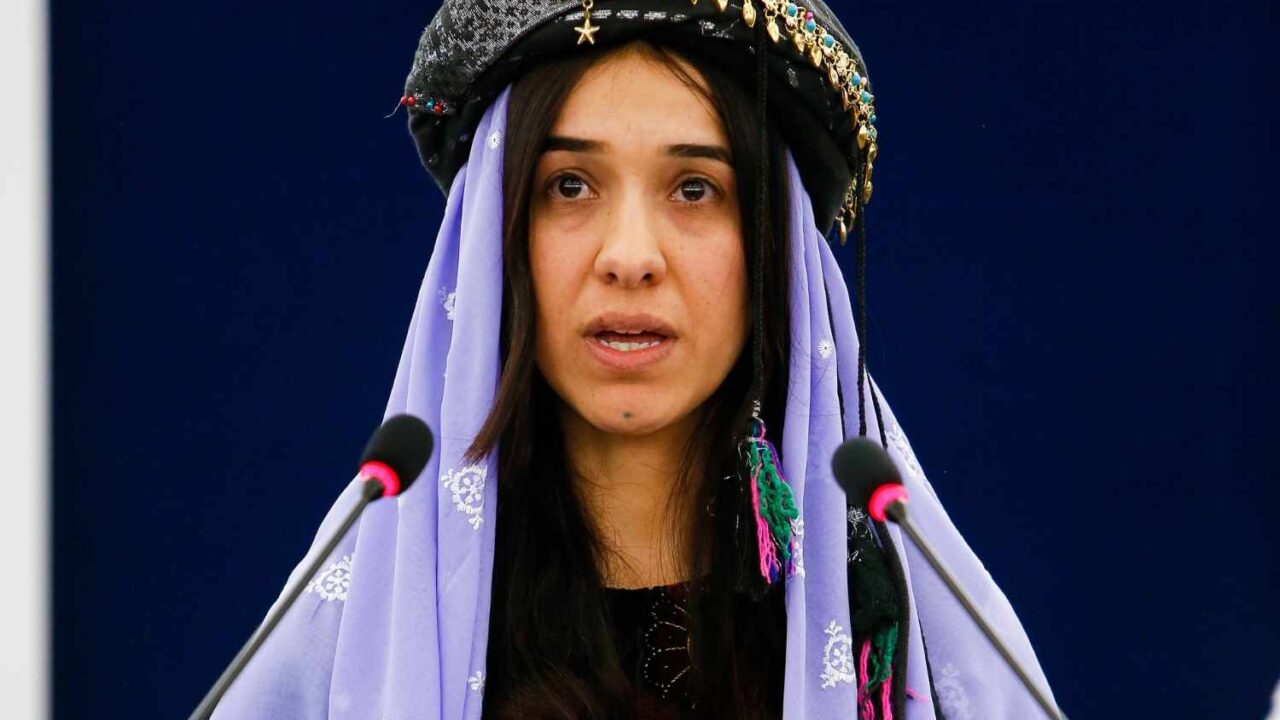
Nobel Peace Prize laureate Nadia Murad has warned that Ezidi survivors are still struggling to be recognised as human beings rather than being reduced to testimonies and evidence of genocide.
Speaking during a press briefing organised by the French mission to the United Nations in Geneva, Murad criticised the continuing failure to deliver justice twelve years after ISIS attacked Sinjar and carried out a systematic campaign to destroy the Ezidi people.
“We’re still fighting to be seen as human beings,” Murad said. She explained that survivors were fighting not only for justice, but also for their identity and the right not to be defined solely by the crimes committed against them.
Murad said that receiving the Nobel Peace Prize had helped her meet political leaders and government representatives, but had not necessarily produced meaningful action. Survivors repeatedly recount the same experiences and receive promises, she said, yet governments often fail to respond when contacted afterwards.
At least 2,000 women and children remain missing
According to the report, families still have no information about at least 2,000 Ezidi women and children abducted by ISIS.
Some of the missing children may have been raised and indoctrinated by ISIS or used in its military operations. Murad referred to her own nephew, who was only weeks old when he was abducted.
She also warned that the military defeat of ISIS in March 2019 did not result in a systematic search for abducted Ezidi women and girls.
Murad said some were held inside private homes by ISIS-supporting families in places including Mosul and Raqqa. After the fall of ISIS-held territory, those families were able to return to ordinary life while continuing to hold Ezidi women and girls in captivity.
Survivors demand prosecutions
Murad was joined in Geneva by six other Ezidi women who had survived ISIS captivity and lost members of their families.
Plans for an international tribunal in Iraq to prosecute major ISIS crimes never materialised. Only a limited number of cases have resulted in convictions in European countries, including Germany and Belgium.
The survivors said the genocide could not truly be considered over while those responsible for killing, enslaving and abducting Ezidis remained unpunished.
Khawla Ali, an Ezidi survivor now living in Germany, said recent convictions had provided some relief. However, she warned that ISIS members who had returned to Europe sometimes appeared to enjoy greater freedom than their victims.
While perpetrators could move without fear, she said, survivors continued to look over their shoulders and live with constant anxiety.
Evidence collected, but justice remains absent
The United Nations Investigative Team to Promote Accountability for Crimes Committed by Da’esh/ISIL, known as UNITAD, was established to collect evidence of ISIS crimes and assist with identifying victims recovered from mass graves.
Its mandate was brought to an end at the request of Iraq before the evidence collected had resulted in widespread prosecutions.
Murad criticised the international community for repeatedly moving from one crisis to another without resolving earlier atrocities or delivering justice to their victims.
She argued that accountability is also essential to preventing future crimes. When perpetrators are allowed to escape punishment, she said, they retain the opportunity to target other people elsewhere.
“Prevention begins with justice and accountability,” Murad said.
Twelve years after the genocide began, Ezidi families continue to wait for missing relatives, the identification and return of victims’ remains, prosecutions of ISIS members and conditions that would allow displaced Ezidis to return safely to Sinjar.