

Australia
Two separate court proceedings in Australia and the Netherlands have again placed attention on the prosecution of women linked to ISIS, including one case involving the alleged enslavement of an Ezidi teenager in Syria and another involving the recruitment of a child soldier.
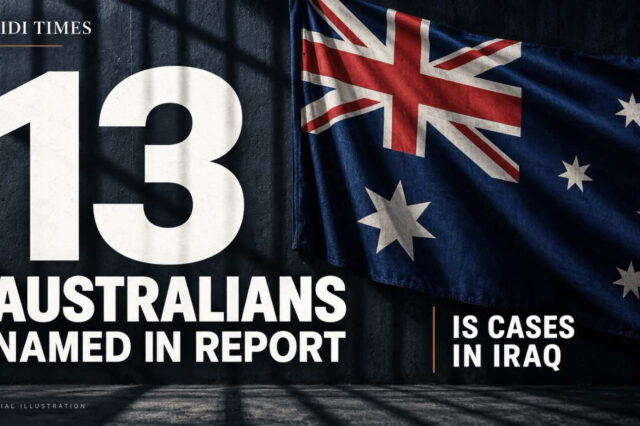
In Australia, 31-year-old Zeinab Ahmad is seeking bail before the Melbourne Magistrates’ Court after being charged with two slavery-related offences. She is accused of involvement in the enslavement and use of an Ezidi teenager who was allegedly held inside the Ahmad family home in Raqqa, Syria, during 2017 and 2018, when the city was under ISIS control.
Ahmad has not been convicted, and the case remains before the court. The allegations, however, are extremely serious. The Ezidi survivor has stated that she was held in the family home, forced into servitude and subjected to abuse. The court also heard allegations that Mohammed Ahmad, Zeinab Ahmad’s father, bought the teenager and subjected her to sexual and physical violence. He is reportedly held in prison in Iraq.
Ahmad’s defence argued that she could be released under strict conditions, including electronic monitoring, phone surveillance and participation in a religious counselling program. Her uncle, Abraham Abbas, also offered to host her and her daughter at his home in Melbourne. Prosecutors and police opposed bail, arguing that such conditions would not sufficiently address the alleged risk to public safety.
The bail proceedings are expected to continue on 15 June. The case is being closely watched because Ahmad faces charges connected to crimes against humanity, including enslavement and use of a slave. Each charge carries a maximum penalty of 25 years in prison if she is convicted.
Netherlands
In a separate case in the Netherlands, the District Court of The Hague sentenced a 49-year-old Dutch woman, identified as Ayada K., to seven years in prison for war crimes. The court found that she had allowed her minor son to be recruited as a child soldier by ISIS after travelling to Syria with her children in 2014.
According to the court, the woman travelled to Syria with two children, then aged 13 and 14. Her son was later taken into ISIS training camps and then into an ISIS police unit. The court concluded that by remaining in ISIS-held territory, she created the opportunity for her son to be recruited as a child soldier. The court treated this as a war crime.
The two cases differ in facts, jurisdictions and legal status. In Australia, the proceedings remain at the bail stage and the accused has not been convicted. In the Netherlands, the court has already issued a conviction and prison sentence. Together, however, they show a wider legal shift: women associated with ISIS are increasingly being prosecuted not only for membership or support, but also for direct or indirect involvement in international crimes.
For Ezidis, the Australian case is especially significant. ISIS’s genocide against the Ezidi people included mass killing, forced displacement, abduction, sexual slavery and forced conversion. Women and girls were targeted because they were Ezidi and because of their Sharfadin faith. Many survivors are still waiting for justice, while thousands of families continue to live with the consequences of captivity, displacement and loss.
The prosecution of enslavement cases is therefore not only a matter of individual criminal responsibility. It is also part of the broader struggle to document the genocide, recognise the crimes committed against Ezidis and ensure that those who participated in ISIS’s system of slavery and persecution are held accountable.