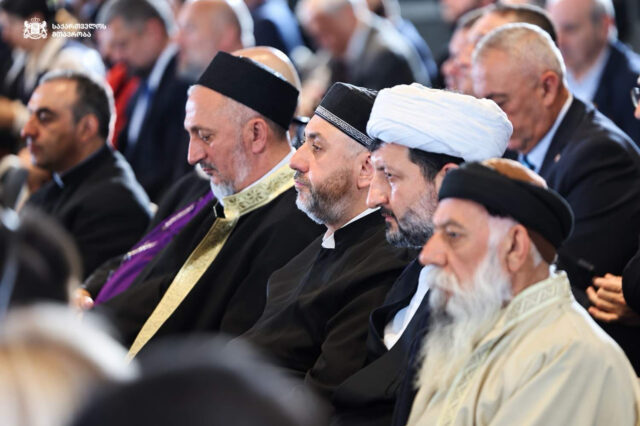
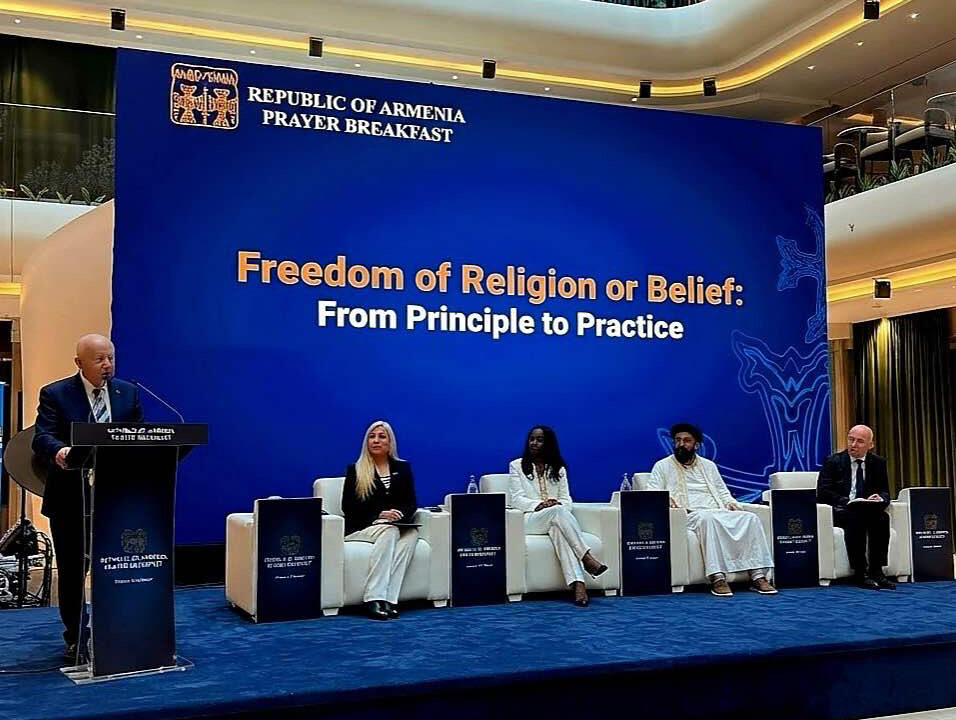
On October 2–3, Yerevan hosted the second “Armenia Prayer Breakfast,” a two-day international event attended by representatives of political, governmental, diplomatic, business, and religious circles from Armenia and abroad. The event also brought together representatives of various religious and national minorities, including Ezidis.
The “Prayer Breakfast” serves as a platform for faith, prayer, religious freedom, peace, and dialogue among different political, national, and religious communities. At the Armenia Prayer Breakfast, Prime Minister Nikol Pashinyan also addressed Armenia’s national and religious communities, noting that although the majority of Armenia’s population is Christian and belongs to the Armenian Apostolic Church, the country is also home to representatives of other religious and national groups. He mentioned Ezidis, Russians, Assyrians, Jews, Greeks, Georgians, and representatives of other nationalities, emphasizing that Ezidis have their own faith.
Pashinyan also spoke about his visit to Armenia’s largest Ezidi sanctuary, noting:
“As far as I understand, I am the first leader of Armenia who has ever visited this sanctuary.”
Prime Minister Nikol Pashinyan
The Prime Minister also addressed the possibility of people of different denominations praying together, noting that the “Prayer Breakfast” format provides an opportunity for people of different faiths and religious traditions to gather and pray together without allowing doctrinal differences to become an obstacle.
The Ezidi people constitute the largest national minority in Armenia. According to the 2022 census, more than 31,000 Ezidis permanently reside in Armenia. Ezidis predominantly live in rural settlements. Their religion, Sharfadin, as well as their language, culture, and traditions, plays an important role in Ezidi life. One of the important centres of Ezidi life in Armenia is the village of Aknalich in Armavir Province, where the Ezidi temple Quba Mere Diwane is located.
Dimitri Pir Bari, also known as Pir Dima, the Chairman of the Spiritual Council of the Ezidis of Georgia, also spoke at the Armenia Prayer Breakfast. Dimitri Pir Bari is one of the spiritual and intellectual figures of the Ezidis in Georgia. He is engaged in the study of Ezidi religion, culture, and spiritual heritage, as well as research and educational work in the field of Ezidi studies. His activities include the study of Ezidi script, manuscripts, religious traditions, and spiritual heritage. An important part of his work is also the transmission of Ezidi religious knowledge and tradition and the preservation of cultural heritage. At the beginning of his speech, Pir Bari addressed freedom of conscience and religion, the protection of the rights of religious and ethnoreligious minorities, and the interconnectedness of Ezidi faith and national identity.
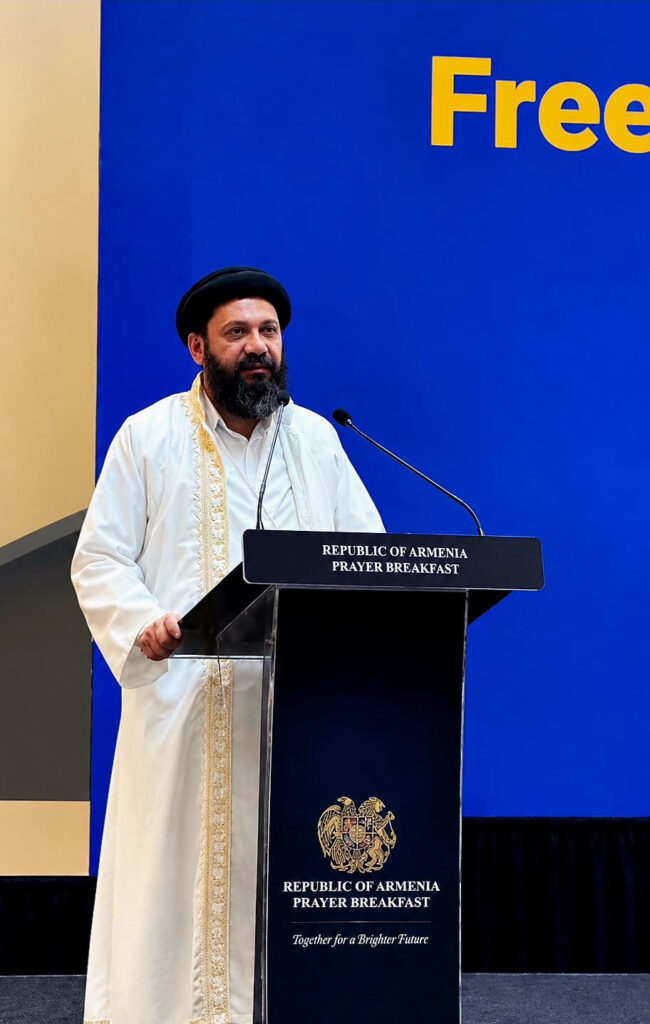
“First of all, I would like to greet you on behalf of the Ezidi people and the Ezidi clergy. Today, one could say that I am here representing the voice of one of the most persecuted religions and peoples in the world. I would also like to thank the organizers of today’s event for the invitation.
Freedom of conscience and religion is rightly regarded as one of the fundamental principles of a modern democratic society and one of the most important components of international human rights standards. Every person is guaranteed the right to independently choose their beliefs, to profess any religion, or not to profess any religion at all. Within the international legal system, the protection of religious and ethnoreligious minorities and the preservation of their cultural and spiritual heritage are of particular importance. However, the real test of this principle lies in how states and the international community protect not only religious groups, but also ethnoreligious peoples for whom faith is a matter of physical and spiritual survival.
This is particularly evident in the case of the Ezidis, a small ethnoreligious people whose total population is approximately one million. A significant part of the Ezidi population lives in northern Iraq, in its historical homeland. Others live in Syria, Turkey, Armenia, Georgia, Russia, Germany, the United States, and other parts of Western Europe. We respect every person’s right to their personal faith and convictions, firmly believing that God is one and that, by His will, different religions, languages, and cultures exist in the world. For the Ezidis, however, faith is not simply a religion; it is the foundation and structure of the people itself. Therefore, the loss of religion is the loss of ethnic identity. The Ezidi faith is connected to the other monotheistic Abrahamic religions. However, for a long time it was transmitted exclusively through a strict oral tradition.
Historically, the Ezidi people have faced serious challenges because of their ethnoreligious exclusivity. It is not possible to convert to our faith, which makes the Ezidi people vulnerable to assimilation. The centuries-old history of the Ezidis shows that this people can preserve its identity under secular states where the social order is based on the rule of law, equality of citizens before the law, and democratic institutions. A historical example of good-neighbourly relations can be found in the events when, fleeing persecution in the Ottoman Empire, Ezidis, together with Assyrians and Armenians, found refuge and safety in neighbouring countries, including Armenia and Georgia. However, even in the modern period, the rights of Ezidis have been violated repeatedly.
In this part of his speech, Pir Bari presented Ezidi faith not only as a religious belief but also as a foundation of national identity, emphasizing that for ethnoreligious peoples, freedom of religion is often directly connected with the survival of the people and the preservation of its cultural heritage. From this point, he turned to the historical and contemporary experiences of the Ezidi people, addressing in particular the tragic events of 2014, their consequences, security concerns, the situation of displaced people, the protection of religious sanctuaries, and the challenges facing Ezidis in Iraq and the diaspora.
In 2014, the Ezidi people in Iraq experienced tragic events that were recognized by the international community as genocide and were carried out by terrorists of the Islamic State. The mass destruction of sanctuaries, the abduction of women, their enslavement, and the severe suffering they endured came as a profound shock to the entire civilized world. Unfortunately, no one protected the Ezidis in time, leaving the civilian population alone in the face of the terrorist threat. This exposed the depth of their security crisis and vulnerability. Following these events, the Ezidi people have been deeply traumatized, and the consequences of this tragedy—the thousands of refugees and destroyed homes—have still not been overcome. Today, the right to freedom of conscience of Ezidis is exercised differently depending on the region. In their historical homeland, Iraq, Ezidis face security and social marginalization. Many of them are forced to live in camps for internally displaced persons, while their sanctuaries require comprehensive protection. A reliable guarantee for the security and preservation of the Ezidi people in their historical homeland could be the establishment in Iraq, in areas with significant Ezidi and Christian populations, including parts of the Nineveh Plains and Sinjar, of local self-government with a special legal status that would ensure the protection of these vulnerable minorities.
At the same time, there is some concern that, following the events of 2014, certain missionary organizations in Iraq have been actively operating among Ezidis under the guise of humanitarian assistance, taking advantage of people’s vulnerability following the trauma they have experienced. In the diaspora, Ezidis, thanks to the principles of a secular legal order, enjoy the freedom to perform their religious rites and have the opportunity to build temples and places of worship. However, serious challenges also arise here. In addition to natural cultural assimilation and the loss of language among younger generations, Ezidis face situations in which former members not only abandon the faith of their ancestors but also publicly engage in discrediting Ezidi traditions and values. Converting voluntarily to another religion is, of course, a personal choice of every individual. However, in practice, such decisions, when made without sufficient awareness and understanding, become a serious loss for our small people. Often, those who have left the faith continue to preserve Ezidi traditions, wish to be buried according to Ezidi rites, and, over time, ask to return to the embrace of the Ezidi faith.
The conversion of several thousand Ezidis to another religion will not fundamentally change the number of followers of the dominant religions. However, for our small ethnic group, it will represent a significant blow. While respecting the principle of freedom of conscience, we hope for the careful preservation of the historically established peace among ethnic and religious communities.
In this part of his speech, Pir Bari demonstrated that the preservation of Ezidi identity, as presented in his remarks, is inseparably connected both with the memory of historical tragedy and with contemporary issues of security, cultural heritage, and the demographic and religious stability of the Ezidi people. He also spoke about assimilation in the diaspora, the loss of language, and the difficulties of preserving religious identity, while emphasizing the importance of the principle of freedom of conscience.
Dimitri Pir Bari’s address at the Armenia Prayer Breakfast presented the preservation of Ezidi identity, faith, and spiritual heritage not merely as an internal concern of one people, but as part of the broader question of protecting religious freedom and cultural diversity. In his speech, historical memory, religious identity, and the security of the Ezidi people converged around one central idea: the survival of small peoples is directly connected to the preservation of their faith, language, and cultural heritage. For Armenia, this issue has particular resonance because the country is also an important centre of the historical presence and life of the Ezidi people.