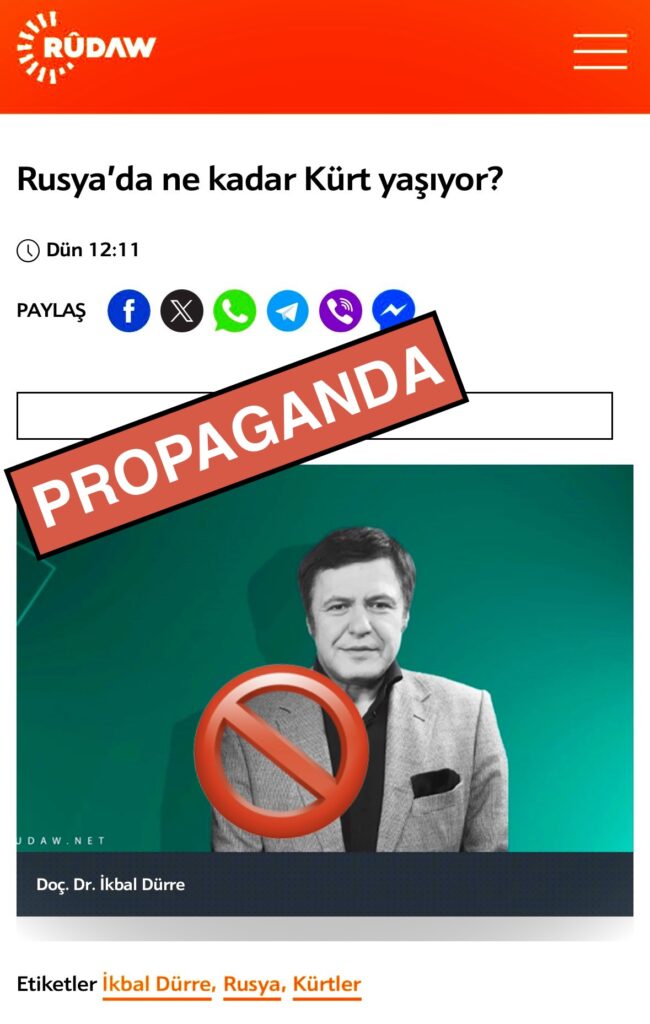
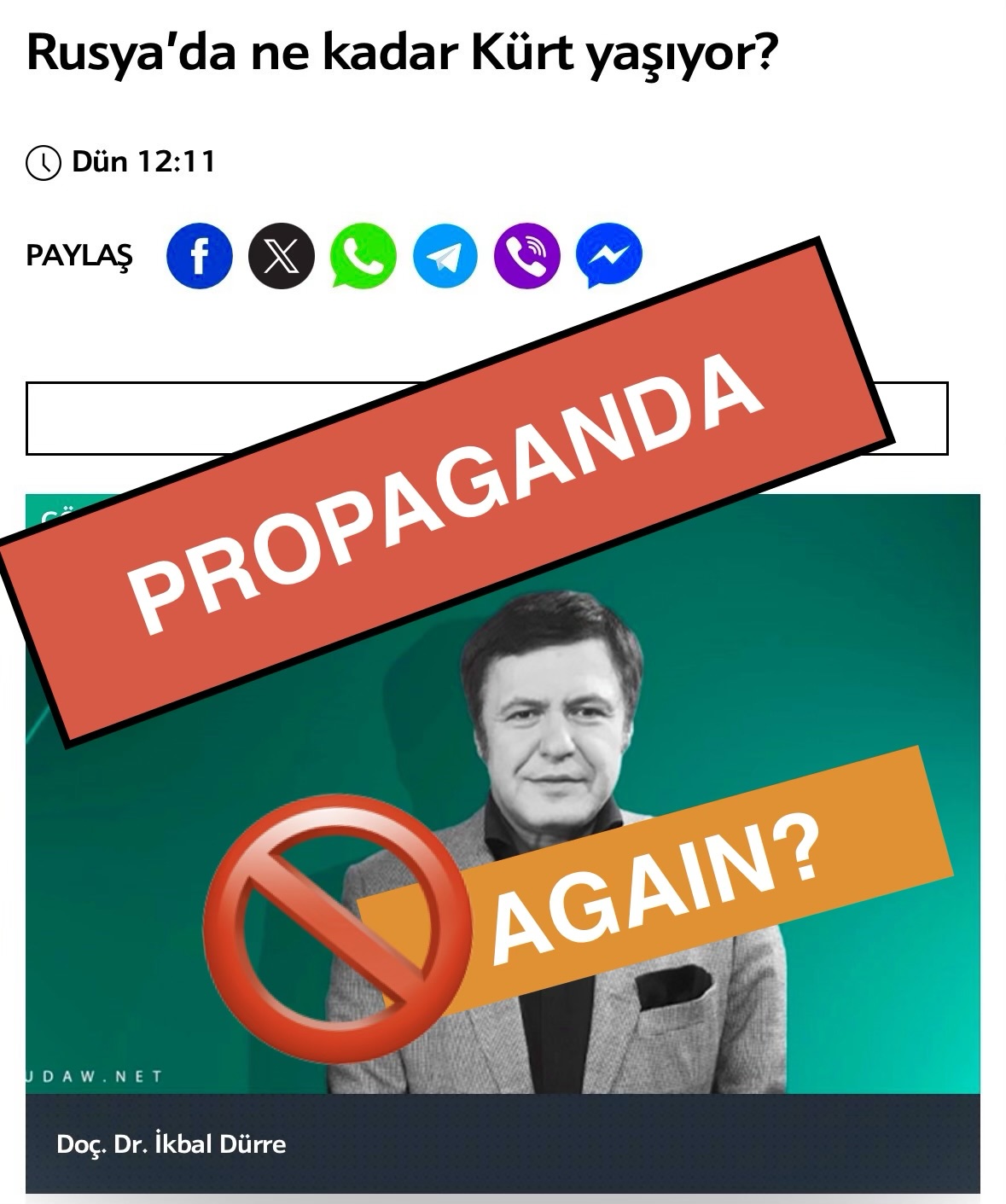
In a recent opinion piece in Rüdaw, İkbal Dürre makes several claims about the number of Kurds in Russia and argues that official figures are inaccurate because, according to him, “Ezidi Kurds” identify simply as “Ezidi.” His argument, however, rests on assumptions that ignore history, identity, and basic logic.
His argument is that Ezidis are Kurds too and that the current statistic number about the number of Kurds in Russia are wrong. He claims that Ezidis too should be counted as Kurds.
Ezidi Times couldn’t refrain from addressing these inaccurate, politically motivated, false statements İkbal Dürre is making. Because silence and inactivity too can be dangerous if we allow people like him insist on speaking over an entire people while attempting to forcefully absorb them into an identity they do not belong to.
İkbal Dürre you are wrong becaue:
1. Who decides how Russia counts its citizens? Certainly not foreign commentators.
Dürre repeatedly implies that Russia’s official statements about population numbers are flawed because they do not reflect his personal estimates. But Russia, like any sovereign state, conducts its own census and determines how citizens can self-identify. If several hundred thousands of Ezidis in Russia register as Ezidi, that is their legal right and it is also a recognition of their distinct ethnic (ezidi) and religious (sharfadin) heritage.
What authority does an external commentator have to dispute how individuals choose to identify themselves in an official Russian census?
2. Ezidis are not Kurds and that is precisely why they are not counted as Kurds.
The argument that Russia “miscounts” its Kurdish population because Ezidis identify as Ezidi rather than Kurdish ignores a fundamental fact: Ezidis are a people of their own, with an ancient ethnic identity and a faith—Sharfadin—that predates and stands separate from “Kurdish” identity.
If Ezidis do not identify as Kurds, and Russia records them accordingly, that is not an error.
It is accuracy, a fact.
Forcing Ezidis into Kurdish demographic numbers is simply rewriting people’s identities to fit someone else’s political (kurdifying and kurdification) narrative.
3. “Kurdish citizens”? Where, exactly?
Dürre refers to Ezidis in Russia as “Kurdish citizens.”
But there is no such citizenship.
Citizens of Russia are Russian citizens.
Ezidis in Russia have never been subjects or citizens of any “kurdish-run” state, nor have they lived under “kurdish authority” in the Russian Federation.
If they have never interacted with “kurdish administrations”, how can anyone label them “Kurdish citizens”?
The term is not only inaccurate, it is invented and a false (artificial) narrative.
4. Why attempt to label Ezidis in Russia as Kurds?
Finally, Dürre’s insistence on classifying Ezidis as Kurds raises a deeper question:
Why is there a constant effort to absorb Ezidis (and Assyrians too for that matter!) into Kurdish identity, especially when Ezidis explicitly define themselves otherwise?
Is it another attempt to take credit for the cultural, professional, and social achievements that Ezidis have built in Russia over generations? Is it an effort to appropriate their success, their recognition, their contributions, and rebrand them under a different ethnic banner?
Ezidis in Russia have established their own institutions, cultural centers, public figures, and respected positions in society. They are recognized as Ezidis: nothing more, nothing less. Reducing them to an ethnic label they reject is not demographic analysis; it is cultural imperialism.
5. Identity is not a numbers game
What Dürre presents as demographic expertise is, in reality, an attempt to reshape a people’s identity according to his and other Kurdish extremists own political worldview. But Ezidis do not belong to anyone. Their heritage is older than the categories he tries to impose, and their right to self-identify is not up for negotiation.
Russia counts Ezidis as Ezidis because that is who they are. And no opinion piece or distorted writing can change that.
And finally…
After all, let’s not forget that the biggest reason why such large numbers of Ezidis live in Russia is the genocide committed against them in 1915—carried out by the Ottoman authorities and by the Kurdish groups who participated in those atrocities. Ezidis were killed, looted, and driven out. They were forced to abandon their ancestral lands, and after surviving, rebuilding, and establishing themselves in new countries, there is now an attempt to label them as “Kurdish.”
This is exactly what people mean when they say “Kurdish logic”.